---
title: "Subtler scopes: Where IRA drug negotiations meet Part D redesigns"
description: Explore how the IRA's drug price negotiations and Part D redesign affect pharmaceutical revenue and strategy, revealing new opportunities and challenges for manufacturers.
image: https://blog.healthverity.com/hubfs/New%20HV%20Blogs%20July%202026/Subtler%20scopes_Where%20IRA%20drug%20negotiations%20meet%20Part%20D%20redesigns.webp
---
Announcing HealthVerity Precision Event Alerts, a next-generation physician alerting solution. [Learn more](https://healthverity.com/news/healthverity-precision-event-alerts-launch/)
- [Contact](https://healthverity.com/contact/)
- [Sign In](https://marketplace.healthverity.com/login/?next=/marketplace/)
[](https://healthverity.com/)
- How We Help
- Featured Content
- [HealthVerity MarketplaceTM](https://healthverity.com/marketplace/healthverity-marketplace/)
- [HealthVerity TaxonomySM](https://healthverity.com/taxonomy-portal/)
- [Life Sciences](https://healthverity.com/life-sciences/)
- [Identity Manager (HVID)](https://healthverity.com/identity-manager/)
- Data Ecosystem
- [HealthVerity MarketplaceTM](https://healthverity.com/marketplace/healthverity-marketplace/)
- [HealthVerity TaxonomySM](https://healthverity.com/taxonomy-portal/)
- [Precision Event Alerts](https://healthverity.com/precision-event-alerts/)
- [HealthVerity Mastersets](https://healthverity.com/mastersets/portal/)
- [Media Measurement](https://healthverity.com/media-measurement/)
- [Insurance Underwriting](https://healthverity.com/insurance-underwriting/)
- Technology Products
- [Identity Manager (HVID)](https://healthverity.com/identity-manager/)
- [HealthVerity FLOW](https://healthverity.com/flow/portal/)
- [Governance Manager](https://healthverity.com/governance-manager/)
- [Smart Contracts](https://healthverity.com/smart-contracts-manager/)
- Symphony
- Symphony Health Platform
- [Symphony Health Overview](https://healthverity.com/symphony-health/overview/)
- [Integrated Dataverse](https://healthverity.com/symphony-health/integrated-dataverse-and-source-solutions/)
- [Symphony HealthCloud](https://healthverity.com/symphony-health/health-technology-and-business-intelligence-solutions/)
- Symphony Solutions
- [Health technology and business intelligence solutions](https://healthverity.com/symphony-health/health-technology-and-business-intelligence-solutions/)
- [Integrated Dataverse and Source Solutions](https://healthverity.com/symphony-health/integrated-dataverse-and-source-solutions/)
- [Brand strategy and sales](https://healthverity.com/symphony-health/optimize-brand-strategy-and-sales-effectiveness/)
- [HealthRankings](https://healthverity.com/symphony-health/health-rankings/)
- [Market access](https://healthverity.com/symphony-health/solve-market-access-challenges/)
- [Patient Journey](https://healthverity.com/symphony-health/understand-the-patient-journey/)
- [Medicines affordability](https://healthverity.com/symphony-health/making-medicines-more-affordable/)
- Symphony Products
- [PayerSource®](https://blog.healthverity.com/hubfs/HealthVerity-Symphony-PDFs/HealthVerity-Symphony-Health-Factsheet-PayerSource.pdf)
- [PrescriberSource®](https://blog.healthverity.com/hubfs/HealthVerity-Symphony-PDFs/HealthVerity-Symphony-Health-Factsheet-PrescriberSource.pdf)
- [PatientSource®](https://blog.healthverity.com/hubfs/HealthVerity-Symphony-PDFs/HealthVerity-Symphony-Health-Factsheet-PatientSource.pdf)
- [PatientSourceCompleteTM](https://blog.healthverity.com/hubfs/HealthVerity-Symphony-PDFs/HealthVerity-Symphony-Health-Factsheet-PatientSourceComplete.pdf)
- [PatientSourceDUOTM](https://blog.healthverity.com/hubfs/HealthVerity-Symphony-PDFs/HealthVerity-Symphony-Health-Factsheet-PatientSourceDUO.pdf)
- [Symphony FLEXTM](https://blog.healthverity.com/hubfs/HealthVerity-Symphony-PDFs/HealthVerity-Symphony-Health-Factsheet-Symphony-FLEX.pdf)
- [CustomerSource®](https://healthverity.com/symphony-health/integrated-dataverse-and-source-solutions/)
- [DiagnosticSource®](https://blog.healthverity.com/hubfs/HealthVerity-Symphony-PDFs/HealthVerity-Symphony-Health-Factsheet-DiagnosticSource.pdf)
- [NonRetailSource®](https://blog.healthverity.com/hubfs/HealthVerity-Symphony-PDFs/HealthVerity-Symphony-Health-Factsheet-NonRetailSource.pdf)
- Symphony Technology
- [Symphony HealthCloud](https://healthverity.com/symphony-health/health-technology-and-business-intelligence-solutions/)
- [Synoma Data Integration](https://healthverity.com/symphony-health/health-technology-and-business-intelligence-solutions/)
- [Vantage Applications](https://blog.healthverity.com/hubfs/HealthVerity-Symphony-PDFs/HealthVerity-Symphony-Health-Factsheet-Vantage-Applications.pdf)
- [Metys](https://healthverity.com/symphony-health/health-technology-and-business-intelligence-solutions/metys/)
- Who We Serve
- [Life Sciences](https://healthverity.com/life-sciences/)
- [Government](https://healthverity.com/government/)
- [Insurance](https://healthverity.com/insurance/)
- [Channel Partners](https://healthverity.com/channel-partners/)
- [Data Ecosystem Partners](https://healthverity.com/data-ecosystem-partners/)
- Resources
- [HealthVerity Blog](https://blog.healthverity.com/)
- [News & Events](https://healthverity.com/resources/news-and-events/)
- [Resource Library](https://healthverity.com/resources/resource-library/)
- [Publications](https://healthverity.com/resources/publications/)
- [The IPGE Approach](https://healthverity.com/ipge-approach/)
- [Zombie Data Explained](https://healthverity.com/get-verified/)
- [Careers](https://healthverity.com/careers/)
- [About Us](https://healthverity.com/about-us/)
[Request Demo](https://healthverity.com/request-demo/)
[Contact](https://healthverity.com/contact/) [Sign In](https://marketplace.healthverity.com/)
[](https://healthverity.com/)
- How We Help
- Symphony
- Who We Serve
- Resources
- [Careers](https://healthverity.com/careers/)
- [About Us](https://healthverity.com/about-us/)
[Request Demo](https://healthverity.com/request-demo/)
Featured Content
###### HealthVerity MarketplaceTM
The nation’s largest healthcare and consumer data ecosystem
###### taXonomy Pathways
Unique features per therapeutic area with claims, labs and EHR including notes
###### HealthVerity eXOs
AI-native real-world evidence generation
###### Identity Manager (HVID)
Standalone de-identification as a service
Data Ecosystem
HealthVerity MarketplaceTM
HealthVerity TaxonomySM
HealthVerity Notes
Precision Event Alerts
HealthVerity Mastersets
Media Measurement
Syndicated Audiences
Insurance Underwriting
Technology Products
Identity Manager (HVID)
HealthVerity for Clinical Trial Linkage
HealthVerity for Commercial
Smart Contracts
HealthVerity for Registries
Symphony Health Platform
###### Symphony Health Overview
Seamless Data. Stronger Insights. Smarter Decisions.
###### Integrated Dataverse
Integrated Dataverse (IDV®) is de-identified claims data platform that combines medical, hospital, prescription, and demographic data into a single unifed view.
###### Symphony HealthCloud
Securely store, integrate, access, and analyze virtually unlimited volumes of data with Symphony HealthCloud.
Symphony Solutions
Health technology and business intelligence solutions
Integrated Dataverse and Source Solutions
Brand strategy and sales
HealthRankings
Market access
Patient Journey
Medicines affordability
Symphony Products
PayerSource®
PrescriberSource®
PatientSource®
PatientSourceCompleteTM
PatientSourceDUOTM
Symphony FLEXTM
CustomerSource®
DiagnosticSource®
NonRetailSource®
Symphony Technology
Symphony HealthCloud
Synoma Data Integration
Vantage Applications
Metys
###### Life Sciences
Technology solutions from development through commercialization
###### Channel Partners
HealthVerity enables partners to unlock unprecedented value and insights for clients
###### Government
Comprehensive and compliant solutions to manage the nation’s care
###### Data Ecosystem Partners
Join the nation’s largest data partner ecosystem
###### Insurance
Insurance-grade solutions that excel in managing risk and rebates
###### HealthVerity Blog
Insights and updates from industry experts
###### Publications
Peer-reviewed research and discoveries
###### News & Events
Stay informed about our latest announcements and happenings
###### The IPGE Approach
Fundamentals that power everything that we do and every solution we offer
###### Resource Library
Explore guides, webinars, and tools to enhance your understanding
###### Zombie Data Explained
Learn how data quality drives better research outcomes
[Thought Leadership](https://blog.healthverity.com/tag/thought-leadership), [Marketplace](https://blog.healthverity.com/tag/marketplace), [Government](https://blog.healthverity.com/tag/government)
# Subtler scopes: Where IRA drug negotiations meet Part D redesigns
[By - Clayton Hale, MS,](https://blog.healthverity.com/author/clayton-hale-ms) July 10, 2026

## 
## Understanding how the IRA’s multiple provisions interact to induce cost-related change
The Inflation Reduction Act (IRA) ushers in numerous changes for the pharmaceutical sector. The law is recognizable for its two headliner provisions:
1. Mandated Part D and Part B drug price negotiations, where for the first time Medicare has directly engaged with pharmaceutical manufacturers to leverage the power of the nation’s largest insurer to limit price
2. A redesign of the Part D benefit featuring a cap of $2,000 in 2025 for Part D beneficiary out-of-pocket (OOP) spend
These two policies, ambitious in their own right, seek to achieve different and divergent policy objectives and will require [strategic considerations from pharma sponsors](https://blog.healthverity.com/navigating-the-impacts-of-the-inflation-reduction-act-ira-strategic-considerations-for-pharma). The federal government, according to estimates from the Congressional Budget Office, hopes to recoup some $98.5 billion in savings by 2031 through securing lower prices for the selected high-cost Part D and Part B drugs subject to negotiation. These savings, however, will be partially offset by the increase in drug spending prompted by a more generous Part D benefit – which, while a benefit for patients, will undoubtedly [increase costs](https://www.cbo.gov/system/files/2022-09/PL117-169_9-7-22.pdf) for the program.1
More challenging than reconciling the competing individual provisions of the law is understanding how its provisions come together, interact and provide often counterintuitive implications. One area this holds particularly true is how the policies above converge around how drugs selected for price negotiation are treated by the changes to the Part D program. Between price negotiations, discounts and exemptions, it will be vital for sponsors to analyze the potential impact to overall drug revenue under the IRA.
## How the IRA is changing program financing
The redesign to the Part D program is much more than an OOP cap, it’s a fundamental change to how the program costs are financed. As shown in the figure below, costs are shifted away from the government and patients onto plans and manufacturers.
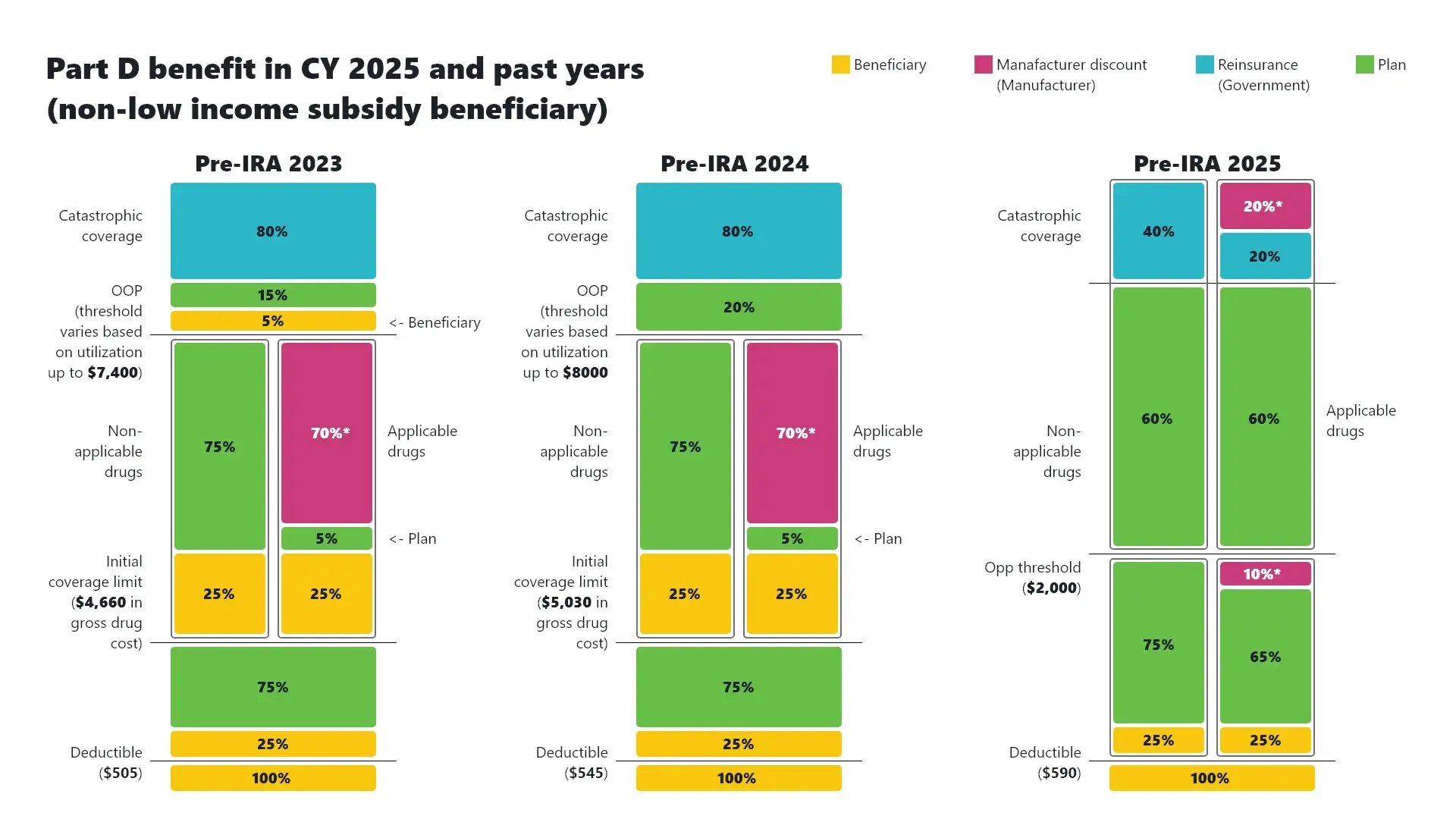
*Image taken from: [CMS](https://www.cms.gov/newsroom/fact-sheets/final-cy-2025-part-d-redesign-program-instructions-fact-sheet)*
One particularly important provision for the pharmaceutical sector is the new mandatory drug discount program represented above by the cost that is due to drug manufacturers. The redesign of the discount program will help to reduce costs for the government and patients by shifting costs onto manufacturers by broadening the base of drugs subject to its reach. Specifically, the new Part D Manufacturer Discount Program for 2025 requires the manufacturer to provide a 10% discount on branded drugs after a patient reaches their deductible. The discount is increased to 20% following the patient’s OOP max with no upper threshold. In contrast, the previous law offered a discount with a higher raw percentage value (70%) but it was only applicable in the coverage gap and the discount obligation went away entirely in the catastrophic phase of spending.
## Analyzing Part D discounts and drug costs
The exact implications of the Part D redesign on a specific product depends on where the drug exists in the cumulative drug spend of its users. Interestingly, manufacturers making drugs for patients (specifically for patients that were consuming drugs in the coverage gap previously but who never reached the out-of-pocket spend that pushed them into the catastrophic phase) could potentially stand to benefit as they now face a reduced mandatory discount.
On the other side of the counter, the very high-cost products that dominated OOP spend and pushed beneficiaries into the catastrophic phases of spending in previous years will face higher discount burdens, since in the catastrophic phase there was no previous discount obligation. Importantly, drugs subject to price negotiations are exempted from these mandatory discounts, further creating opportunities for the change to benefit certain manufacturers. With all the variables impacting the drug costs, even the drugs selected for price negotiation could end up with increased revenue.
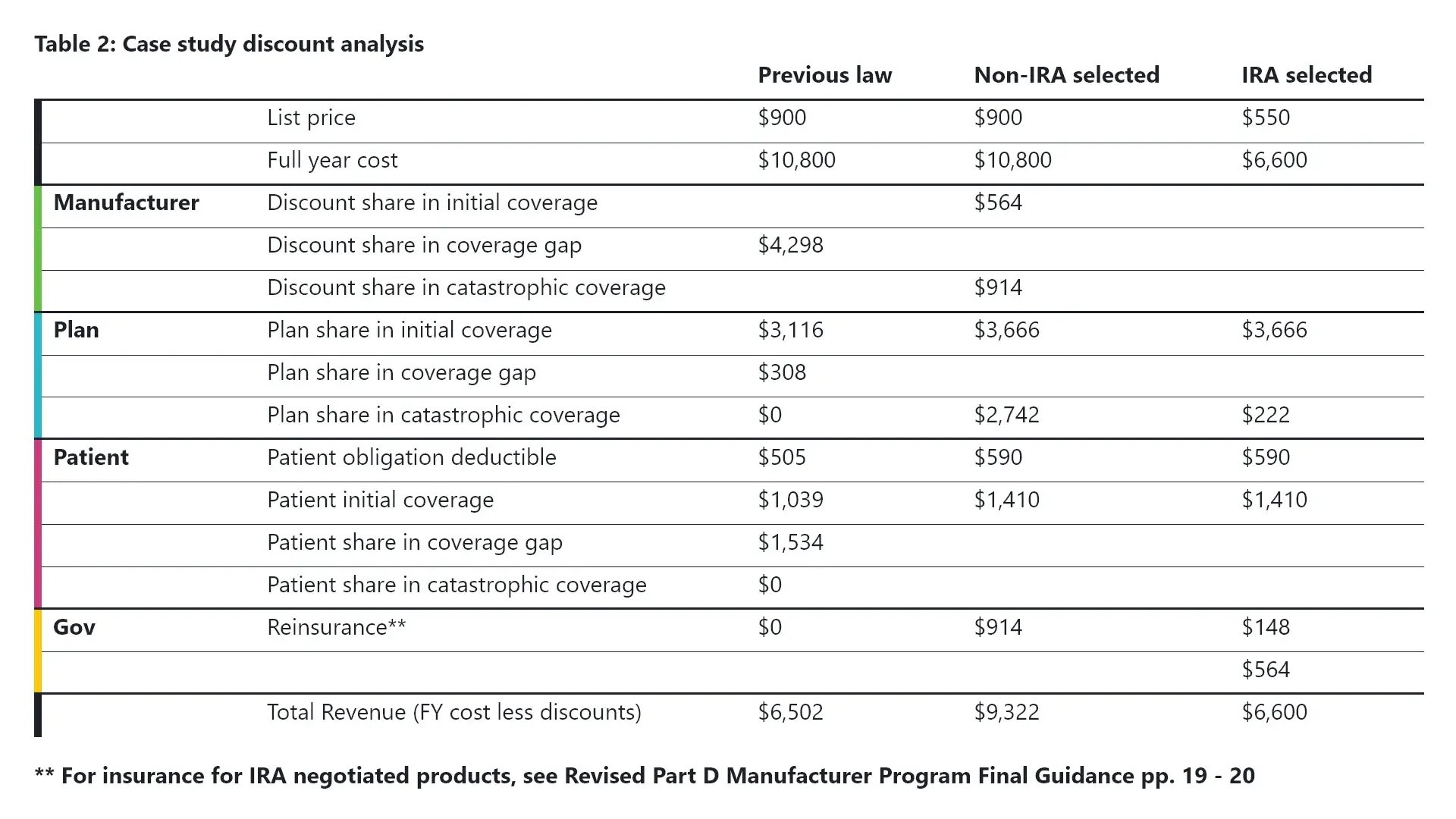
So how could this shake out? Here’s a simple analysis: Consider the case of an individual taking a single branded drug with a list price of $900 taken monthly. The drug is selected for negotiations and the price is reduced by nearly 40% to $550. Table 2 shows how the drug would be financed under the standard benefit design for years prior as well as how the drug is treated under the Part D redesign, both with its previous price and with the new IRA-negotiated price.
The result: Because the drug is exempted from the manufacturer discount program, despite a 40% reduction in price the drug still generates more revenue than it did pre-IRA.
*\*\*For reinsurance for IRA negotiated products, see [Revised Medicare Part D Manufacturer Discount Program Final Guidance pp. 19 - 20](https://www.cms.gov/files/document/manufacturer-discount-program-final-guidance.pdf)*
## Data-driven IRA strategy
The tabulation above just scratches the surface. Patients often take multiple products composed of a mix of generic and branded drugs that further complicates the analysis and necessitates context-specific fine tuning. Symphony Health, a HealthVerity company, has the requisite breadth and depth of data to tailor such analyses to derive exactly when and how Medicare patients consume specific products as they progress through the new Part D phases. For manufacturers of negotiated products, facing market dynamics with a product at a novel price point, understanding and actively shaping how your product is consumed will be key to capitalizing on the potential lurking in the IRA. Competitors of maximum fair price (MFP) products should familiarize themselves with this environment, realizing the competitors may not be hit as hard as initially imagined.
[Connect with us](https://healthverity.com/integration-contact/) to discover how Symphony Health, a HealthVerity company, can leverage its robust data to help develop new strategies for success under the IRA changes.
[](https://blog.healthverity.com/hs/cta/wi/redirect?encryptedPayload=AVxigLKlMSop9QiypJK0GfkjO%2B0cd7FnWcoPxEBT3%2FZr0BqZN6KKgneEc7%2FXQyswOsydI93jNMlSJvU2lwhFN9G3W6a23Srl2muJPqCp5G8Yh%2F%2FjXezB%2BLT%2Bn03xuUWQp1lJX95zw1OKgIB43ytgI7HDAHVjOwSu8B7esWVh32CYHa0jA2MQLYwz25T4E2RDYbkteA%3D%3D&webInteractiveContentId=217076346249&portalId=5412465)
### References
1. *Congressional Budget Office*
[https://www.cbo.gov/system/files/2022-09/PL117-169\_9-7-22.pdf](https://www.cbo.gov/system/files/2022-09/PL117-169_9-7-22.pdf)
[](https://blog.healthverity.com/hs/cta/wi/redirect?encryptedPayload=AVxigLKHvXo%2BA82kUDTa2uhT5s3tb93EfT4dMVZdZgA%2FQzFG2i0wDq%2B4B4GdOhZwW3nZ1MMyxAy94fWeVHY8X%2FoB6QGmKViI%2F7SPpKn%2F491s7Bnk5%2BLvejj15avkpcGDRpdt4Uz6wMgBrZknOmZIbb2QouXVZRSTDnGJlfKVpojwyFQhhsve7LIIa1g%3D&webInteractiveContentId=195733501532&portalId=5412465)
###### Category
- [Solutions & Best Practices](https://blog.healthverity.com/tag/solutions-best-practices)
- [Trends & Insights](https://blog.healthverity.com/tag/trends-insights)
- [HEOR](https://blog.healthverity.com/tag/heor)
- [Thought Leadership](https://blog.healthverity.com/tag/thought-leadership)
- [Marketplace](https://blog.healthverity.com/tag/marketplace)
- [taXonomy](https://blog.healthverity.com/tag/taxonomy)
- [Industry Updates](https://blog.healthverity.com/tag/industry-updates)
- [Case Studies](https://blog.healthverity.com/tag/case-studies)
- [Commercial Pharmaceutical](https://blog.healthverity.com/tag/commercial-pharmaceutical)
- [Government](https://blog.healthverity.com/tag/government)
- [AI](https://blog.healthverity.com/tag/ai)
- [eXOs](https://blog.healthverity.com/tag/exos)
- [Audiences](https://blog.healthverity.com/tag/audiences)
- [taXonomy Pathways](https://blog.healthverity.com/tag/taxonomy-pathways)
- [Notes](https://blog.healthverity.com/tag/notes)
- [Rare Diseases](https://blog.healthverity.com/tag/rare-diseases)
###### Popular Post
- [The GLP-1 trend: What the real-world data reveals](https://blog.healthverity.com/the-glp-1-surge-what-the-real-world-data-reveals)
- [GLP-1 trends 2025: real-world data, patient outcomes & future therapies](https://blog.healthverity.com/glp-1-trends-2025-real-world-data-patient-outcomes-future-therapies)
- [Open claims vs. closed payer claims: What’s the difference?](https://blog.healthverity.com/open-claims-vs-closed-payer-claims)
- [What is Privacy Preserving Record Linkage (PPRL)?](https://blog.healthverity.com/what-is-privacy-preserving-record-linkage)
- [GLP‑1 real‑world data for obesity: A new standard for metabolic care](https://blog.healthverity.com/glp-1-real-world-data-for-obesity-a-new-standard-for-metabolic-care)
###### Subscribe
### Similar Blogs
[](https://blog.healthverity.com/disparities-in-opioid-use-disorder-oud-treatment-buprenorphine-vs.-naltrexone)
#### [Disparities in OUD treatment: Buprenorphine vs. naltrexone](https://blog.healthverity.com/disparities-in-opioid-use-disorder-oud-treatment-buprenorphine-vs.-naltrexone)
By [HealthVerity](https://blog.healthverity.com/author/healthverity) 19 August 2025
Understanding disparities in opioid use disorder (OUD) treatment Pharmaceutical companies committed...
[READ MORE](https://blog.healthverity.com/subtler-scopes-where-ira-drug-negotiations-meet-part-d-redesigns)
[](https://blog.healthverity.com/johnson-johnson-real-world-study-using-healthverity-marketplace)
#### [J&J's real-world bladder cancer study started in HealthVerity Marketplace](https://blog.healthverity.com/johnson-johnson-real-world-study-using-healthverity-marketplace)
By [HealthVerity](https://blog.healthverity.com/author/healthverity) 22 July 2025
High-risk NMIBC: Disease overview and treatment approach Johnson & Johnson quickly identified and...
[READ MORE](https://blog.healthverity.com/subtler-scopes-where-ira-drug-negotiations-meet-part-d-redesigns)
[](https://blog.healthverity.com/connecting-data-to-contextualize-the-complex-diabetes-journey)
#### [Connecting Data to Contextualize the Complex Diabetes Journey](https://blog.healthverity.com/connecting-data-to-contextualize-the-complex-diabetes-journey)
By [HealthVerity](https://blog.healthverity.com/author/healthverity) 30 November 2022
Diabetes is a complex disease that affects over 37 million Americans, or 11% of the population, and...
[READ MORE](https://blog.healthverity.com/subtler-scopes-where-ira-drug-negotiations-meet-part-d-redesigns)
#### Who we serve
- [Life Sciences](https://healthverity.com/life-sciences/)
- [Government](https://healthverity.com/government/)
- [Insurance](https://healthverity.com/insurance/)
- [Channel Partners](https://healthverity.com/channel-partners/)
- [Data Ecosystem Partners](https://healthverity.com/data-ecosystem-partners/)
#### How we help
- [HealthVerity Marketplace](https://healthverity.com/marketplace/)
- [HealthVerity Mastersets](https://healthverity.com/mastersets/)
- [HealthVerity FLOW](https://healthverity.com/flow/)
- [The IPGE Approach](https://healthverity.com/ipge-approach/)
#### Resources
- [HealthVerity Blog](https://blog.healthverity.com/)
- [News & Events](https://healthverity.com/resources/news-and-events/)
- [Resource Library](https://healthverity.com/resources/resource-library/)
- [Publications](https://healthverity.com/resources/publications/)
#### Our company
- [About Us](https://healthverity.com/about-us/)
- [Leadership](https://healthverity.com/about-us/#leadership)
- [Board of Directors](https://healthverity.com/about-us/#board)
- [Careers](https://healthverity.com/careers/)
- [Contact](https://healthverity.com/contact/)
©2026 HealthVerity, Inc. | [Terms & Conditions](https://healthverity.com/terms-and-conditions/) | [Privacy Policy](https://healthverity.com/privacy-policy/)
