
Capturing the true complexity of psoriasis in the real world
Psoriasis is a common chronic inflammatory disease affecting roughly 2-3% of U.S. adults (over 7.5 million people) making it one of the most prevalent immune-mediated conditions in the country.1 While its presentation is visible on the skin, the disease is driven by a complex immune response involving both innate and adaptive mechanisms. Recent insights point to the key roles of cytokines such as IL-17 and IL-23, along with immune cells like Th17 and ILC3, in triggering and sustaining psoriatic inflammation.1 These immune circuits are also linked to broader systemic risks, including cardiovascular disease, metabolic syndrome and other inflammatory conditions.
Beyond its visible skin lesions, psoriasis carries a profound burden on patients’ health and quality of life. Many individuals develop serious comorbidities such as psoriatic arthritis, cardiovascular disease, metabolic syndrome, and depression. Moderate to severe cases often require systemic therapy, yet patients can face a long journey of trial-and-error treatments and unmet needs. In fact, nearly one-quarter of people with psoriasis have moderate-to-severe disease, but over 40% of those are not receiving the systemic therapies recommended by clinical guidelines, pointing to significant treatment gaps in real-world practice.2
Such gaps in care, combined with the lifelong nature of psoriasis, result in substantial healthcare and economic burdens – with annual U.S. healthcare costs for psoriasis estimated in the tens of billions of dollars (over $100 billion by some analyses).3 These realities underscore the importance of robust outcomes research in psoriasis and the need for comprehensive real-world data to inform that research.
Insights from real-world data on psoriasis comorbidities, severity and biologic use
Real-world data (RWD) offers essential insight into the complexities of psoriasis beyond what clinical trials can capture. In a large U.S. electronic health record study, patients with more severe psoriasis were far more likely to develop psoriatic arthritis, with incidence rates rising from 2.1 to 17.6 cases per 100 patient-years depending on treatment severity. a signal that integrating claims with EHR can surface critical predictors like comorbidities and preclinical symptoms.4
Similarly, a claims-based analysis of more than 25,000 patients revealed wide variation in treatment adherence and persistence across biologics, with ustekinumab and guselkumab showing the strongest durability over nine months.5 Together, these studies demonstrate how RWD supports a more accurate picture of disease progression, treatment performance and unmet needs in the real world.
Real-world evidence is becoming increasingly important as it informs regulatory, clinical, and commercial strategy across the product lifecycle.6 One researcher from Pfizer notes that real-world data can drive decisions around label expansions, safety monitoring, and payer value demonstration when trials fall short of capturing long-term outcomes or broad populations.6 For chronic conditions like psoriasis, where disease burden and treatment dynamics vary widely, these insights are increasingly essential.
Why claims data alone can’t explain real-world psoriasis outcomes
Psoriasis is a complex inflammatory disease with variable symptoms, comorbidities, and treatment responses that evolve over time and taXonomy Pathways enables researchers to ask and answer key questions about these research topics with better data:
- Who meets criteria for advanced therapy? Integrated data reveals which patients truly have severe disease, using BSA, flare frequency and comorbidities like psoriatic arthritis, to define more accurate cohorts.
- How do treatment patterns evolve? Analysts can follow real-world therapy sequences, from topicals to biologics, assess titration, and measure duration on treatment before discontinuation or switching.
- What outcomes do patients achieve? Linked claims and clinical data allow evaluation of inflammation markers, skin improvement, and healthcare utilization, as well as trends in comorbid conditions.
- Which safety signals emerge? Labs and notes surface issues missed in claims—such as liver enzyme elevations, infections, or unstructured mentions of adverse events.
- Why do patients switch or stop therapy? Physician notes provide real-world context on discontinuation, capturing issues like lack of efficacy, side effects, or payer restrictions that are invisible in structured data.
While claims can show when a patient initiated or switched therapy, they often miss the clinical context that matters most. For health economics and outcomes research (HEOR) and epidemiology, claims-only studies leave key evidence gaps, including:
- Body surface area (BSA) affected to stratify disease severity
- RAPID3 scores and pain scale ratings to evaluate functional impact
- Inflammatory markers like C-reactive protein (CRP) and lipid panels that track systemic burden
- Clinical notes capturing symptoms like morning stiffness, fatigue, or reduced mobility
- Patient-reported outcomes that speak to quality of life or reasons for discontinuation
These are essential metrics for identifying disease progression, treatment response, and emerging comorbidities. Claims may confirm a filled prescription for a psoriasis biologic, but they won’t show that a patient’s pain increased, RAPID3 score worsened, or joint symptoms emerged in the months that followed (Figure 1). Without structured EHR and physician notes, these warning signs go unmeasured.
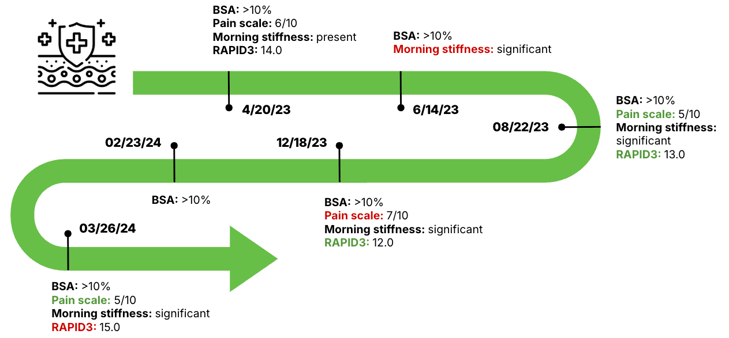
Figure 1: A typical psoriasis patient pathway including data not available in closed claims alone.
How taXonomy Pathways supports psoriasis RWE with claims, EHR, labs and notes
taXonomy Pathways bridges this gap by integrating closed payer claims with EHR data, labs, and more than 3.6 billion de-identified physician notes (Figure 2). This longitudinal view allows researchers to build precise psoriasis cohorts, track symptom and lab-based outcomes, and surface the real reasons why patients switch, stop, or escalate treatment. Whether for HEOR, safety, or real-world effectiveness studies, taXonomy Pathways gives you a comprehensive context.

Figure 2: the taXonomy Pathways solution integrating closed claims with structured EHR, lab results and physician notes
Ready to go deeper with your psoriasis research?
If you’re exploring real-world outcomes for therapies like Skyrizi®, Tremfya®, or other psoriasis treatments, we can help design a study that goes beyond claims. Tell us your population of interest and endpoints. With taXonomy Pathways, we’ll deliver a custom-tailored dataset and analysis framework you won’t find in claims data alone.

References
- Yamanaka K, Yamamoto O, Honda T. Pathophysiology of psoriasis: A review. The Journal of Dermatology. 2021;48(6):722-731. doi:10.1111/1346-8138.15913
- Lebwohl, M. G., Langley, R. G., Paul, C., et al. (2012). Evolution of patient perceptions of psoriatic disease: results from the National Psoriasis Foundation’s UPLIFT survey, 2003–2011. PLoS ONE, 7(12): e52935. doi: 10.1371/journal.pone.0052935
- Brezinski, E. A., Dhillon, J. S., Armstrong, A. W. (2015). Economic burden of psoriasis in the United States: a systematic review. JAMA Dermatology, 151(6), 651-658. doi: 10.1001/jamadermatol.2014.3593
- Merola JF, Tian H, Patil D, et al. Incidence and prevalence of psoriatic arthritis in patients with psoriasis stratified by psoriasis disease severity: Retrospective analysis of an electronic health records database in the United States. Journal of the American Academy of Dermatology. 2022;86(4):748-757. doi:10.1016/j.jaad.2021.09.019
- Xu C, Teeple A, Wu B, Fitzgerald T, Feldman SR. Drug adherence and persistence of patients with moderate to severe psoriasis treated with biologic medications in a U.S. commercially insured population. Dermatology. 2022;238(3):438-447. doi:10.1159/000519176
- Dagenais S, Russo L, Madsen A, Webster J, Becnel L. Use of real‐world evidence to drive drug development strategy and inform clinical trial design. Clin Pharma and Therapeutics. 2022;111(1):77-89. doi:10.1002/cpt.2480