---
title: Inside taXonomy, a next-gen closed claims solution for real-world evidence generation
description: Healthcare audience targeting relies on open claims and predictive modeling. Learn why transparency in data and methodology improves performance.
image: https://blog.healthverity.com/hubfs/claim-better-outcomes-blog.png
---
Announcing HealthVerity Precision Event Alerts, a next-generation physician alerting solution. [Learn more](https://healthverity.com/news/healthverity-precision-event-alerts-launch/)
- [Contact](https://healthverity.com/contact/)
- [Sign In](https://marketplace.healthverity.com/login/?next=/marketplace/)
[](https://healthverity.com/)
- How We Help
- Featured Content
- [HealthVerity MarketplaceTM](https://healthverity.com/marketplace/healthverity-marketplace/)
- [HealthVerity TaxonomySM](https://healthverity.com/taxonomy-portal/)
- [Life Sciences](https://healthverity.com/life-sciences/)
- [Identity Manager (HVID)](https://healthverity.com/identity-manager/)
- Data Ecosystem
- [HealthVerity MarketplaceTM](https://healthverity.com/marketplace/healthverity-marketplace/)
- [HealthVerity TaxonomySM](https://healthverity.com/taxonomy-portal/)
- [Precision Event Alerts](https://healthverity.com/precision-event-alerts/)
- [HealthVerity Mastersets](https://healthverity.com/mastersets/portal/)
- [Media Measurement](https://healthverity.com/media-measurement/)
- [Insurance Underwriting](https://healthverity.com/insurance-underwriting/)
- Technology Products
- [Identity Manager (HVID)](https://healthverity.com/identity-manager/)
- [HealthVerity FLOW](https://healthverity.com/flow/portal/)
- [Governance Manager](https://healthverity.com/governance-manager/)
- [Smart Contracts](https://healthverity.com/smart-contracts-manager/)
- Symphony
- Symphony Health Platform
- [Symphony Health Overview](https://healthverity.com/symphony-health/overview/)
- [Integrated Dataverse](https://healthverity.com/symphony-health/integrated-dataverse-and-source-solutions/)
- [Symphony HealthCloud](https://healthverity.com/symphony-health/health-technology-and-business-intelligence-solutions/)
- Symphony Solutions
- [Health technology and business intelligence solutions](https://healthverity.com/symphony-health/health-technology-and-business-intelligence-solutions/)
- [Integrated Dataverse and Source Solutions](https://healthverity.com/symphony-health/integrated-dataverse-and-source-solutions/)
- [Brand strategy and sales](https://healthverity.com/symphony-health/optimize-brand-strategy-and-sales-effectiveness/)
- [HealthRankings](https://healthverity.com/symphony-health/health-rankings/)
- [Market access](https://healthverity.com/symphony-health/solve-market-access-challenges/)
- [Patient Journey](https://healthverity.com/symphony-health/understand-the-patient-journey/)
- [Medicines affordability](https://healthverity.com/symphony-health/making-medicines-more-affordable/)
- Symphony Products
- [PayerSource®](https://blog.healthverity.com/hubfs/HealthVerity-Symphony-PDFs/HealthVerity-Symphony-Health-Factsheet-PayerSource.pdf)
- [PrescriberSource®](https://blog.healthverity.com/hubfs/HealthVerity-Symphony-PDFs/HealthVerity-Symphony-Health-Factsheet-PrescriberSource.pdf)
- [PatientSource®](https://blog.healthverity.com/hubfs/HealthVerity-Symphony-PDFs/HealthVerity-Symphony-Health-Factsheet-PatientSource.pdf)
- [PatientSourceCompleteTM](https://blog.healthverity.com/hubfs/HealthVerity-Symphony-PDFs/HealthVerity-Symphony-Health-Factsheet-PatientSourceComplete.pdf)
- [PatientSourceDUOTM](https://blog.healthverity.com/hubfs/HealthVerity-Symphony-PDFs/HealthVerity-Symphony-Health-Factsheet-PatientSourceDUO.pdf)
- [Symphony FLEXTM](https://blog.healthverity.com/hubfs/HealthVerity-Symphony-PDFs/HealthVerity-Symphony-Health-Factsheet-Symphony-FLEX.pdf)
- [CustomerSource®](https://healthverity.com/symphony-health/integrated-dataverse-and-source-solutions/)
- [DiagnosticSource®](https://blog.healthverity.com/hubfs/HealthVerity-Symphony-PDFs/HealthVerity-Symphony-Health-Factsheet-DiagnosticSource.pdf)
- [NonRetailSource®](https://blog.healthverity.com/hubfs/HealthVerity-Symphony-PDFs/HealthVerity-Symphony-Health-Factsheet-NonRetailSource.pdf)
- Symphony Technology
- [Symphony HealthCloud](https://healthverity.com/symphony-health/health-technology-and-business-intelligence-solutions/)
- [Synoma Data Integration](https://healthverity.com/symphony-health/health-technology-and-business-intelligence-solutions/)
- [Vantage Applications](https://blog.healthverity.com/hubfs/HealthVerity-Symphony-PDFs/HealthVerity-Symphony-Health-Factsheet-Vantage-Applications.pdf)
- [Metys](https://healthverity.com/symphony-health/health-technology-and-business-intelligence-solutions/metys/)
- Who We Serve
- [Life Sciences](https://healthverity.com/life-sciences/)
- [Government](https://healthverity.com/government/)
- [Insurance](https://healthverity.com/insurance/)
- [Channel Partners](https://healthverity.com/channel-partners/)
- [Data Ecosystem Partners](https://healthverity.com/data-ecosystem-partners/)
- Resources
- [HealthVerity Blog](https://blog.healthverity.com/)
- [News & Events](https://healthverity.com/resources/news-and-events/)
- [Resource Library](https://healthverity.com/resources/resource-library/)
- [Publications](https://healthverity.com/resources/publications/)
- [The IPGE Approach](https://healthverity.com/ipge-approach/)
- [Zombie Data Explained](https://healthverity.com/get-verified/)
- [Careers](https://healthverity.com/careers/)
- [About Us](https://healthverity.com/about-us/)
[Request Demo](https://healthverity.com/request-demo/)
[Contact](https://healthverity.com/contact/) [Sign In](https://marketplace.healthverity.com/)
[](https://healthverity.com/)
- How We Help
- Symphony
- Who We Serve
- Resources
- [Careers](https://healthverity.com/careers/)
- [About Us](https://healthverity.com/about-us/)
[Request Demo](https://healthverity.com/request-demo/)
Featured Content
###### HealthVerity MarketplaceTM
The nation’s largest healthcare and consumer data ecosystem
###### taXonomy Pathways
Unique features per therapeutic area with claims, labs and EHR including notes
###### HealthVerity eXOs
AI-native real-world evidence generation
###### Identity Manager (HVID)
Standalone de-identification as a service
Data Ecosystem
HealthVerity MarketplaceTM
HealthVerity TaxonomySM
HealthVerity Notes
Precision Event Alerts
HealthVerity Mastersets
Media Measurement
Syndicated Audiences
Insurance Underwriting
Technology Products
Identity Manager (HVID)
HealthVerity for Clinical Trial Linkage
HealthVerity for Commercial
Smart Contracts
HealthVerity for Registries
Symphony Health Platform
###### Symphony Health Overview
Seamless Data. Stronger Insights. Smarter Decisions.
###### Integrated Dataverse
Integrated Dataverse (IDV®) is de-identified claims data platform that combines medical, hospital, prescription, and demographic data into a single unifed view.
###### Symphony HealthCloud
Securely store, integrate, access, and analyze virtually unlimited volumes of data with Symphony HealthCloud.
Symphony Solutions
Health technology and business intelligence solutions
Integrated Dataverse and Source Solutions
Brand strategy and sales
HealthRankings
Market access
Patient Journey
Medicines affordability
Symphony Products
PayerSource®
PrescriberSource®
PatientSource®
PatientSourceCompleteTM
PatientSourceDUOTM
Symphony FLEXTM
CustomerSource®
DiagnosticSource®
NonRetailSource®
Symphony Technology
Symphony HealthCloud
Synoma Data Integration
Vantage Applications
Metys
###### Life Sciences
Technology solutions from development through commercialization
###### Channel Partners
HealthVerity enables partners to unlock unprecedented value and insights for clients
###### Government
Comprehensive and compliant solutions to manage the nation’s care
###### Data Ecosystem Partners
Join the nation’s largest data partner ecosystem
###### Insurance
Insurance-grade solutions that excel in managing risk and rebates
###### HealthVerity Blog
Insights and updates from industry experts
###### Publications
Peer-reviewed research and discoveries
###### News & Events
Stay informed about our latest announcements and happenings
###### The IPGE Approach
Fundamentals that power everything that we do and every solution we offer
###### Resource Library
Explore guides, webinars, and tools to enhance your understanding
###### Zombie Data Explained
Learn how data quality drives better research outcomes
[Thought Leadership](https://blog.healthverity.com/tag/thought-leadership), [taXonomy Pathways](https://blog.healthverity.com/tag/taxonomy-pathways)
# Inside taXonomy, a next-gen closed claims solution for real-world evidence generation
[By - John Cosenza,](https://blog.healthverity.com/author/john-cosenza) April 2, 2026

## 
Healthcare claims data are one of the most powerful sources of data in generating real-world evidence (RWE). These data help answer questions about therapeutic area incidence and prevalence, healthcare resource utilization and costs, treatment patterns and where care was rendered and by whom, etc.
Yet, even with modern data platforms, a familiar barrier remains: in a highly competitive environment shaped by shifting patient behavior and data fragmentation, execution of reliable and meaningful longitudinal studies demand assembling claims data that are robust, comprehensive and stable, not simply accessible.
This post is the first in a four-part series on [HealthVerity taXonomy](https://healthverity.com/taxonomy/%60), the industry’s most comprehensive, consistent and curated closed claims dataset designed to power longitudinal study designs across health economics, patient outcomes, epidemiological, and safety and effectiveness initiatives. Today, we’ll discuss the taXonomy build and how it’s differentiated compared to legacy closed claims datasets. ([Read part 2 here](https://blog.healthverity.com/when-billed-and-allowed-amounts-arent-enough))
In subsequent posts, we’ll focus on key topics and features of HealthVerity taXonomy, including the data model design, validation of its mortality data, its novel and proprietary cost data offering and responsible methods that can be used by researchers supporting study execution directly for, or on behalf of, life science organizations.
## The challenge isn’t just data access, it’s reliable and consistent assembly of the data
In longitudinal RWE generation initiatives, the key consideration is often not how the data are applied, but whether the data are sufficiently reliable, consistent and stable to support defensible study design and interpretation. A few limitations that should be considered include:
- **Fragmentation and fixed footprints:** Many datasets are anchored to a fixed payer panel, or even a single payer. This inherently introduces the potential for biases, whether demographic or socioeconomic, geographical or by payer type, it can limit the generalizability of findings or analytic feasibility when study needs evolve.
- **Market Dynamics:** Payer membership, benefit design and provider networks change over time, which can alter the observable population even when study definitions remain constant. Datasets anchored to narrow or static contributors can be especially sensitive to these shifts, complicating interpretation of time trends and generalizability.
- **Longitudinal completeness:** Many RWE questions depend on establishing baseline periods, follow-up windows and continuous enrollment to ensure valid attribution and outcome measurement. Longitudinal completeness is a function of enrollment continuity, coverage breadth. Data sources constrained to a fixed or homogeneous set of payers may limit longitudinal visibility of patient journeys over time.
To summarize, the value of closed claims data is not defined by their availability, but by their methodological integrity and their ability to sustain rigorous, reproducible evidence generation.
## The promise: closed claims that are configurable and transparent
HealthVerity taXonomy is a standardized, carefully assembled and de-duplicated closed claims dataset designed for analytics-ready use, but what differentiates it isn’t simply that it’s “clean” or “curated” (many modern datasets aim for that).
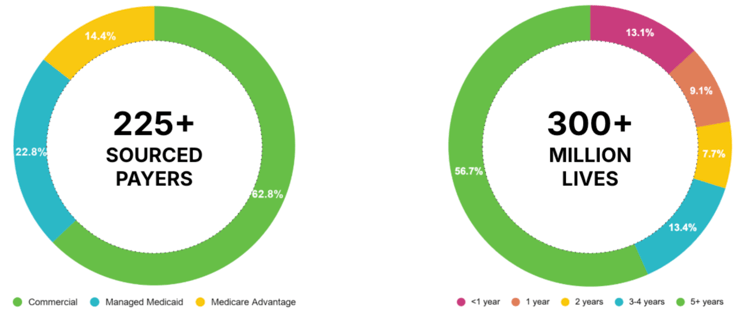
HealthVerity taXonomy payer type and enrollment distribution.
The key difference is that taXonomy is underpinned by the [HealthVerity Marketplace](https://healthverity.com/marketplace/) model, which enables a dynamic approach to building a more reliable closed claims dataset. HealthVerity Marketplace includes the largest dataset of closed claims data in the industry, and we continue to add additional closed claims sources over time, expanding breadth and depth in ways that can help address coverage gaps and strengthen longitudinal analytics. The unique benefit of the marketplace model enables:
- **Configurable supplier footprint over time:** Teams can start with a targeted set of closed claims suppliers and have the option to augment by integrating additional closed claims assets without disrupting their broader approach. This directly addresses common limitations of fixed or narrow payer footprints. As the footprint expands, epidemiologic analyses become more statistically robust and generalizable, supporting detailed evaluation of both common and rare events. Greater scale and diversity can also improve power to detect small but meaningful associations between exposures and outcomes, **reducing the risk of false negatives.**
- **Seamless expansion that strengthens longitudinal follow-up:** Expanding the footprint can increase enrollment coverage and continuity, improving the ability to observe patients consistently across baseline and follow-up windows, an essential requirement for longitudinal cohort studies. By capturing a more complete view of enrollment over time, this approach helps reduce selection bias and supports a more accurate representation of patients’ healthcare activity, so outcomes and findings are comprehensive and less likely to be skewed by over- or under-representation of specific patient groups.
This “configurable foundation” matters because RWE research questions evolve, often quickly, and a static dataset can become a constraint.
## Why we launched the taXonomy blog series for real-world evidence teams
We’re writing this series because we believe rigorous, transparent real-world evidence can improve decision-making across the life sciences industry, and higher quality data is the catalyst in achieving this. By pulling back the curtain on how taXonomy is designed and the value it possesses from a research perspective, we aim to assist research teams produce analyses that are faster to execute and stronger methodologically. In future posts, we’ll go deeper into the components that matter most to RWE teams:
- [**Post 2:**](https://blog.healthverity.com/when-billed-and-allowed-amounts-arent-enough) Cost in claims—how to think about allowed amounts vs standardized benchmarks and best practices for analysis
- **Post 3:** Mortality in RWE—what’s included and how to use it responsibly
- **Post 4:** Under the hood—data model design and why it’s intentionally client-friendly for cohort studies
[](https://blog.healthverity.com/hs/cta/wi/redirect?encryptedPayload=AVxigLIQGrlGepS1AtFgZPYb7NGLWpBsugxQet5ctH%2BjdhT2MbnBaYl%2BVjTdkvAEtr%2B0Iz2FwsZ04Op50X%2FWreqDwJOnyfEft1alfecGLnkpgDwVM0qS5ScCAEEubBZCbZKzD2Kp3lnYD63viDD73JjCVL%2F0ZKLgYLIsVsp5qz2aw5i4M9LX%2BXK344%2Byd9TL3E4l23O7RRx6fwA%3D&webInteractiveContentId=188589266814&portalId=5412465)
[](https://blog.healthverity.com/hs/cta/wi/redirect?encryptedPayload=AVxigLIfdcpvYrJBThW0CyNJGPl4hgtV0O5d63UdQvGTtAUlQr2poMenHskIjEt%2FVOT1Eu8cS9jL0P5vSIHslqx8vn1fpgILOm6HbLoiFcKllrFsDufF8co21N9wjeo8R%2FGYfYxeEgxsqpS%2FWj5WAIsSSFJKPStDCpCHDdqmROnU7Eyn6fWE57o%3D&webInteractiveContentId=209041299597&portalId=5412465)
###### Category
- [Solutions & Best Practices](https://blog.healthverity.com/tag/solutions-best-practices)
- [Trends & Insights](https://blog.healthverity.com/tag/trends-insights)
- [HEOR](https://blog.healthverity.com/tag/heor)
- [Thought Leadership](https://blog.healthverity.com/tag/thought-leadership)
- [Marketplace](https://blog.healthverity.com/tag/marketplace)
- [taXonomy](https://blog.healthverity.com/tag/taxonomy)
- [Industry Updates](https://blog.healthverity.com/tag/industry-updates)
- [Case Studies](https://blog.healthverity.com/tag/case-studies)
- [Commercial Pharmaceutical](https://blog.healthverity.com/tag/commercial-pharmaceutical)
- [Government](https://blog.healthverity.com/tag/government)
- [AI](https://blog.healthverity.com/tag/ai)
- [eXOs](https://blog.healthverity.com/tag/exos)
- [Audiences](https://blog.healthverity.com/tag/audiences)
- [taXonomy Pathways](https://blog.healthverity.com/tag/taxonomy-pathways)
- [Notes](https://blog.healthverity.com/tag/notes)
- [Rare Diseases](https://blog.healthverity.com/tag/rare-diseases)
###### Popular Post
- [The GLP-1 trend: What the real-world data reveals](https://blog.healthverity.com/the-glp-1-surge-what-the-real-world-data-reveals)
- [GLP-1 trends 2025: real-world data, patient outcomes & future therapies](https://blog.healthverity.com/glp-1-trends-2025-real-world-data-patient-outcomes-future-therapies)
- [Open claims vs. closed payer claims: What’s the difference?](https://blog.healthverity.com/open-claims-vs-closed-payer-claims)
- [What is Privacy Preserving Record Linkage (PPRL)?](https://blog.healthverity.com/what-is-privacy-preserving-record-linkage)
- [GLP‑1 real‑world data for obesity: A new standard for metabolic care](https://blog.healthverity.com/glp-1-real-world-data-for-obesity-a-new-standard-for-metabolic-care)
###### Subscribe
### Similar Blogs
[](https://blog.healthverity.com/enterprise-data-strategy-is-your-organization-equipped-to-manage-and-execute-in-todays-world)
#### [Enterprise data strategy: Are you equipped for today’s world?](https://blog.healthverity.com/enterprise-data-strategy-is-your-organization-equipped-to-manage-and-execute-in-todays-world)
By [John Cappiello, CTO, HealthVerity](https://blog.healthverity.com/author/john-cappiello-cto-healthverity) 31 January 2019
By: John Cappiello, HealthVerity CTO The healthcare landscape is changing and the need for an...
[READ MORE](https://blog.healthverity.com/inside-taxonomy-a-next-gen-closed-claims-solution-for-real-world-evidence-generation)
[](https://blog.healthverity.com/why-reliable-mortality-measurement-in-real-world-evidence-matters)
#### [Why reliable mortality measurement in real-world evidence matters](https://blog.healthverity.com/why-reliable-mortality-measurement-in-real-world-evidence-matters)
By [John Cosenza](https://blog.healthverity.com/author/john-cosenza) 4 June 2026
Understanding mortality in taXonomy and the importance of post mortem activity This is the third...
[READ MORE](https://blog.healthverity.com/inside-taxonomy-a-next-gen-closed-claims-solution-for-real-world-evidence-generation)
[](https://blog.healthverity.com/how-to-eliminate-healthcare-data-silos)
#### [The power of interoperability: how to eliminate healthcare data silos](https://blog.healthverity.com/how-to-eliminate-healthcare-data-silos)
By [HealthVerity](https://blog.healthverity.com/author/healthverity) 9 October 2020
The “acceleration of digital health transformation” means many things to many people, but through...
[READ MORE](https://blog.healthverity.com/inside-taxonomy-a-next-gen-closed-claims-solution-for-real-world-evidence-generation)
#### Who we serve
- [Life Sciences](https://healthverity.com/life-sciences/)
- [Government](https://healthverity.com/government/)
- [Insurance](https://healthverity.com/insurance/)
- [Channel Partners](https://healthverity.com/channel-partners/)
- [Data Ecosystem Partners](https://healthverity.com/data-ecosystem-partners/)
#### How we help
- [HealthVerity Marketplace](https://healthverity.com/marketplace/)
- [HealthVerity Mastersets](https://healthverity.com/mastersets/)
- [HealthVerity FLOW](https://healthverity.com/flow/)
- [The IPGE Approach](https://healthverity.com/ipge-approach/)
#### Resources
- [HealthVerity Blog](https://blog.healthverity.com/)
- [News & Events](https://healthverity.com/resources/news-and-events/)
- [Resource Library](https://healthverity.com/resources/resource-library/)
- [Publications](https://healthverity.com/resources/publications/)
#### Our company
- [About Us](https://healthverity.com/about-us/)
- [Leadership](https://healthverity.com/about-us/#leadership)
- [Board of Directors](https://healthverity.com/about-us/#board)
- [Careers](https://healthverity.com/careers/)
- [Contact](https://healthverity.com/contact/)
©2026 HealthVerity, Inc. | [Terms & Conditions](https://healthverity.com/terms-and-conditions/) | [Privacy Policy](https://healthverity.com/privacy-policy/)

```json
{
"@context" : "https://schema.org",
"@type" : "BlogPosting",
"articleSection" : "Real-World Evidence",
"author" : {
"@type" : "Organization",
"name" : "HealthVerity"
},
"dateModified" : "2026-04-01",
"datePublished" : "2026-04-01",
"description" : "Explore HealthVerity taXonomy, a next-generation closed claims dataset designed to deliver reliable, transparent and longitudinal real-world evidence for healthcare and life sciences research.",
"headline" : "Inside taXonomy: A Next-Gen Closed Claims Solution for Real-World Evidence Generation",
"keywords" : [ "closed claims data", "real-world evidence", "HealthVerity taXonomy", "healthcare analytics", "longitudinal studies", "HEOR", "epidemiology", "claims data quality", "healthcare data marketplace", "life sciences research" ],
"mainEntityOfPage" : {
"@id" : "https://blog.healthverity.com/inside-taxonomy-a-next-gen-closed-claims-solution-for-real-world-evidence-generation",
"@type" : "WebPage"
},
"publisher" : {
"@type" : "Organization",
"logo" : {
"@type" : "ImageObject",
"url" : "https://blog.healthverity.com/logo.png"
},
"name" : "HealthVerity"
}
}
```
```json
{
"@context" : "https://schema.org",
"@type" : "FAQPage",
"mainEntity" : [ {
"@type" : "Question",
"acceptedAnswer" : {
"@type" : "Answer",
"text" : "HealthVerity taXonomy is a comprehensive, standardized and de-duplicated closed claims dataset designed to support longitudinal real-world evidence generation across healthcare research, epidemiology and life sciences."
},
"name" : "What is HealthVerity taXonomy?"
}, {
"@type" : "Question",
"acceptedAnswer" : {
"@type" : "Answer",
"text" : "taXonomy addresses challenges such as data fragmentation, fixed payer footprints, shifting market dynamics and gaps in longitudinal completeness, which can impact the reliability and generalizability of real-world evidence studies."
},
"name" : "What challenges does taXonomy address in claims data?"
}, {
"@type" : "Question",
"acceptedAnswer" : {
"@type" : "Answer",
"text" : "taXonomy enables configurable data expansion through the HealthVerity Marketplace, improving enrollment continuity, coverage breadth and patient visibility over time to support more robust longitudinal analyses."
},
"name" : "How does HealthVerity taXonomy improve longitudinal research?"
}, {
"@type" : "Question",
"acceptedAnswer" : {
"@type" : "Answer",
"text" : "Unlike static datasets, taXonomy offers a dynamic and configurable supplier footprint, allowing researchers to expand datasets over time without disrupting study design, improving statistical power and generalizability."
},
"name" : "What makes taXonomy different from legacy closed claims datasets?"
}, {
"@type" : "Question",
"acceptedAnswer" : {
"@type" : "Answer",
"text" : "High-quality, consistent and methodologically sound data are essential for producing reliable, reproducible and defensible real-world evidence that can support decision-making in healthcare and life sciences."
},
"name" : "Why is data quality important for real-world evidence generation?"
} ]
}
```
```json
{
"@context" : "https://schema.org",
"@type" : "BreadcrumbList",
"itemListElement" : [ {
"@type" : "ListItem",
"item" : "https://blog.healthverity.com/",
"name" : "Blog",
"position" : 1
}, {
"@type" : "ListItem",
"item" : "https://blog.healthverity.com/inside-taxonomy-a-next-gen-closed-claims-solution-for-real-world-evidence-generation",
"name" : "Inside taXonomy: A Next-Gen Closed Claims Solution for Real-World Evidence Generation",
"position" : 2
} ]
}
```