---
title: "HPV vaccination trends from 2016 to 2025: Progress and missed opportunities"
description: HPV vaccination rates are improving, but coverage gaps persist. Real-world claims data reveal trends in initiation, completion, and disparities.
image: https://blog.healthverity.com/hubfs/hpv-vaccination-trends-featured-1.png
---
Announcing HealthVerity Precision Event Alerts, a next-generation physician alerting solution. [Learn more](https://healthverity.com/news/healthverity-precision-event-alerts-launch/)
- [Contact](https://healthverity.com/contact/)
- [Sign In](https://marketplace.healthverity.com/login/?next=/marketplace/)
[](https://healthverity.com/)
- How We Help
- Featured Content
- [HealthVerity MarketplaceTM](https://healthverity.com/marketplace/healthverity-marketplace/)
- [HealthVerity TaxonomySM](https://healthverity.com/taxonomy-portal/)
- [Life Sciences](https://healthverity.com/life-sciences/)
- [Identity Manager (HVID)](https://healthverity.com/identity-manager/)
- Data Ecosystem
- [HealthVerity MarketplaceTM](https://healthverity.com/marketplace/healthverity-marketplace/)
- [HealthVerity TaxonomySM](https://healthverity.com/taxonomy-portal/)
- [Precision Event Alerts](https://healthverity.com/precision-event-alerts/)
- [HealthVerity Mastersets](https://healthverity.com/mastersets/portal/)
- [Media Measurement](https://healthverity.com/media-measurement/)
- [Insurance Underwriting](https://healthverity.com/insurance-underwriting/)
- Technology Products
- [Identity Manager (HVID)](https://healthverity.com/identity-manager/)
- [HealthVerity FLOW](https://healthverity.com/flow/portal/)
- [Governance Manager](https://healthverity.com/governance-manager/)
- [Smart Contracts](https://healthverity.com/smart-contracts-manager/)
- Symphony
- Symphony Health Platform
- [Symphony Health Overview](https://healthverity.com/symphony-health/overview/)
- [Integrated Dataverse](https://healthverity.com/symphony-health/integrated-dataverse-and-source-solutions/)
- [Symphony HealthCloud](https://healthverity.com/symphony-health/health-technology-and-business-intelligence-solutions/)
- Symphony Solutions
- [Health technology and business intelligence solutions](https://healthverity.com/symphony-health/health-technology-and-business-intelligence-solutions/)
- [Integrated Dataverse and Source Solutions](https://healthverity.com/symphony-health/integrated-dataverse-and-source-solutions/)
- [Brand strategy and sales](https://healthverity.com/symphony-health/optimize-brand-strategy-and-sales-effectiveness/)
- [HealthRankings](https://healthverity.com/symphony-health/health-rankings/)
- [Market access](https://healthverity.com/symphony-health/solve-market-access-challenges/)
- [Patient Journey](https://healthverity.com/symphony-health/understand-the-patient-journey/)
- [Medicines affordability](https://healthverity.com/symphony-health/making-medicines-more-affordable/)
- Symphony Products
- [PayerSource®](https://blog.healthverity.com/hubfs/HealthVerity-Symphony-PDFs/HealthVerity-Symphony-Health-Factsheet-PayerSource.pdf)
- [PrescriberSource®](https://blog.healthverity.com/hubfs/HealthVerity-Symphony-PDFs/HealthVerity-Symphony-Health-Factsheet-PrescriberSource.pdf)
- [PatientSource®](https://blog.healthverity.com/hubfs/HealthVerity-Symphony-PDFs/HealthVerity-Symphony-Health-Factsheet-PatientSource.pdf)
- [PatientSourceCompleteTM](https://blog.healthverity.com/hubfs/HealthVerity-Symphony-PDFs/HealthVerity-Symphony-Health-Factsheet-PatientSourceComplete.pdf)
- [PatientSourceDUOTM](https://blog.healthverity.com/hubfs/HealthVerity-Symphony-PDFs/HealthVerity-Symphony-Health-Factsheet-PatientSourceDUO.pdf)
- [Symphony FLEXTM](https://blog.healthverity.com/hubfs/HealthVerity-Symphony-PDFs/HealthVerity-Symphony-Health-Factsheet-Symphony-FLEX.pdf)
- [CustomerSource®](https://healthverity.com/symphony-health/integrated-dataverse-and-source-solutions/)
- [DiagnosticSource®](https://blog.healthverity.com/hubfs/HealthVerity-Symphony-PDFs/HealthVerity-Symphony-Health-Factsheet-DiagnosticSource.pdf)
- [NonRetailSource®](https://blog.healthverity.com/hubfs/HealthVerity-Symphony-PDFs/HealthVerity-Symphony-Health-Factsheet-NonRetailSource.pdf)
- Symphony Technology
- [Symphony HealthCloud](https://healthverity.com/symphony-health/health-technology-and-business-intelligence-solutions/)
- [Synoma Data Integration](https://healthverity.com/symphony-health/health-technology-and-business-intelligence-solutions/)
- [Vantage Applications](https://blog.healthverity.com/hubfs/HealthVerity-Symphony-PDFs/HealthVerity-Symphony-Health-Factsheet-Vantage-Applications.pdf)
- [Metys](https://healthverity.com/symphony-health/health-technology-and-business-intelligence-solutions/metys/)
- Who We Serve
- [Life Sciences](https://healthverity.com/life-sciences/)
- [Government](https://healthverity.com/government/)
- [Insurance](https://healthverity.com/insurance/)
- [Channel Partners](https://healthverity.com/channel-partners/)
- [Data Ecosystem Partners](https://healthverity.com/data-ecosystem-partners/)
- Resources
- [HealthVerity Blog](https://blog.healthverity.com/)
- [News & Events](https://healthverity.com/resources/news-and-events/)
- [Resource Library](https://healthverity.com/resources/resource-library/)
- [Publications](https://healthverity.com/resources/publications/)
- [The IPGE Approach](https://healthverity.com/ipge-approach/)
- [Zombie Data Explained](https://healthverity.com/get-verified/)
- [Careers](https://healthverity.com/careers/)
- [About Us](https://healthverity.com/about-us/)
[Request Demo](https://healthverity.com/request-demo/)
[Contact](https://healthverity.com/contact/) [Sign In](https://marketplace.healthverity.com/)
[](https://healthverity.com/)
- How We Help
- Symphony
- Who We Serve
- Resources
- [Careers](https://healthverity.com/careers/)
- [About Us](https://healthverity.com/about-us/)
[Request Demo](https://healthverity.com/request-demo/)
Featured Content
###### HealthVerity MarketplaceTM
The nation’s largest healthcare and consumer data ecosystem
###### taXonomy Pathways
Unique features per therapeutic area with claims, labs and EHR including notes
###### HealthVerity eXOs
AI-native real-world evidence generation
###### Identity Manager (HVID)
Standalone de-identification as a service
Data Ecosystem
HealthVerity MarketplaceTM
HealthVerity TaxonomySM
HealthVerity Notes
Precision Event Alerts
HealthVerity Mastersets
Media Measurement
Syndicated Audiences
Insurance Underwriting
Technology Products
Identity Manager (HVID)
HealthVerity for Clinical Trial Linkage
HealthVerity for Commercial
Smart Contracts
HealthVerity for Registries
Symphony Health Platform
###### Symphony Health Overview
Seamless Data. Stronger Insights. Smarter Decisions.
###### Integrated Dataverse
Integrated Dataverse (IDV®) is de-identified claims data platform that combines medical, hospital, prescription, and demographic data into a single unifed view.
###### Symphony HealthCloud
Securely store, integrate, access, and analyze virtually unlimited volumes of data with Symphony HealthCloud.
Symphony Solutions
Health technology and business intelligence solutions
Integrated Dataverse and Source Solutions
Brand strategy and sales
HealthRankings
Market access
Patient Journey
Medicines affordability
Symphony Products
PayerSource®
PrescriberSource®
PatientSource®
PatientSourceCompleteTM
PatientSourceDUOTM
Symphony FLEXTM
CustomerSource®
DiagnosticSource®
NonRetailSource®
Symphony Technology
Symphony HealthCloud
Synoma Data Integration
Vantage Applications
Metys
###### Life Sciences
Technology solutions from development through commercialization
###### Channel Partners
HealthVerity enables partners to unlock unprecedented value and insights for clients
###### Government
Comprehensive and compliant solutions to manage the nation’s care
###### Data Ecosystem Partners
Join the nation’s largest data partner ecosystem
###### Insurance
Insurance-grade solutions that excel in managing risk and rebates
###### HealthVerity Blog
Insights and updates from industry experts
###### Publications
Peer-reviewed research and discoveries
###### News & Events
Stay informed about our latest announcements and happenings
###### The IPGE Approach
Fundamentals that power everything that we do and every solution we offer
###### Resource Library
Explore guides, webinars, and tools to enhance your understanding
###### Zombie Data Explained
Learn how data quality drives better research outcomes
[Thought Leadership](https://blog.healthverity.com/tag/thought-leadership), [Trends & Insights](https://blog.healthverity.com/tag/trends-insights), [Case Studies](https://blog.healthverity.com/tag/case-studies), [Marketplace (RWD)](https://blog.healthverity.com/tag/marketplace-rwd)
# HPV vaccination trends from 2016 to 2025: Progress and missed opportunities
[By \- Alexandra Miller, MPH,](https://blog.healthverity.com/author/alexandra-miller-mph) March 4, 2026

by: [Alexandra Miller, MPH](https://www.linkedin.com/in/alexandrammiller/)
Human papillomavirus (HPV) is one of the most common sexually transmitted infections in the United States. Almost all sexually active individuals are exposed to HPV at some point in their lifetime. Although most infections are asymptomatic and self-limited, persistent infection with high-risk HPV types can lead to cervical cancer and other malignancies, including anal, oropharyngeal, vulvar, vaginal and penile cancers.1 Approximately 13,000 women are diagnosed with cervical cancer each year in the U.S., and nearly all of these cases are attributable to persistent HPV infection.2,3
Many HPV-related cancers are preventable through timely vaccination. Yet national coverage rates remain below public health targets, leaving preventable cancer risk on the table. March 4th marks International HPV Awareness Day, a global initiative dedicated to raising awareness about HPV and promoting vaccination, screening, and education to prevent HPV-related cancers.
## The role of Gardasil®, the first HPV vaccine
Gardasil® was approved in 2006 for use in adolescent females to prevent cervical cancer. Today, HPV vaccination is recommended for both girls and boys beginning at age 9, with routine vaccination ideally at ages 11–12 and catch-up vaccination recommended through age 26.4 As vaccination programs have matured, national guidelines have increasingly emphasized vaccination at younger ages to maximize pre-exposure protection.5 Gardasil is currently the only active HPV vaccine in the U.S.
Studies have demonstrated substantial reductions in HPV infection and precancerous cervical lesions, as well as a significant decline in cervical cancer incidence among young U.S. women following the introduction of HPV vaccine.6,7
## HPV vaccine initiation trends shifting towards younger patients
Using longitudinal closed medical and pharmacy claims data, we evaluated real-world trends in HPV vaccine initiation and completion from 2016 through 2025 among patients aged 9–26. Figure 1 shows the age distribution of new HPV vaccine initiators over time.
Since 2016, the proportion of initiators in the recommended 11–12 age group has increased substantially from approximately 32% of initiators in 2016 to nearly 49% in 2025. At the same time, initiation among older adolescents and young adults has declined as a share of total initiators. This shift reflects alignment with clinical guidance emphasizing vaccination at ages 11–12 and suggests improving uptake at the recommended age window.
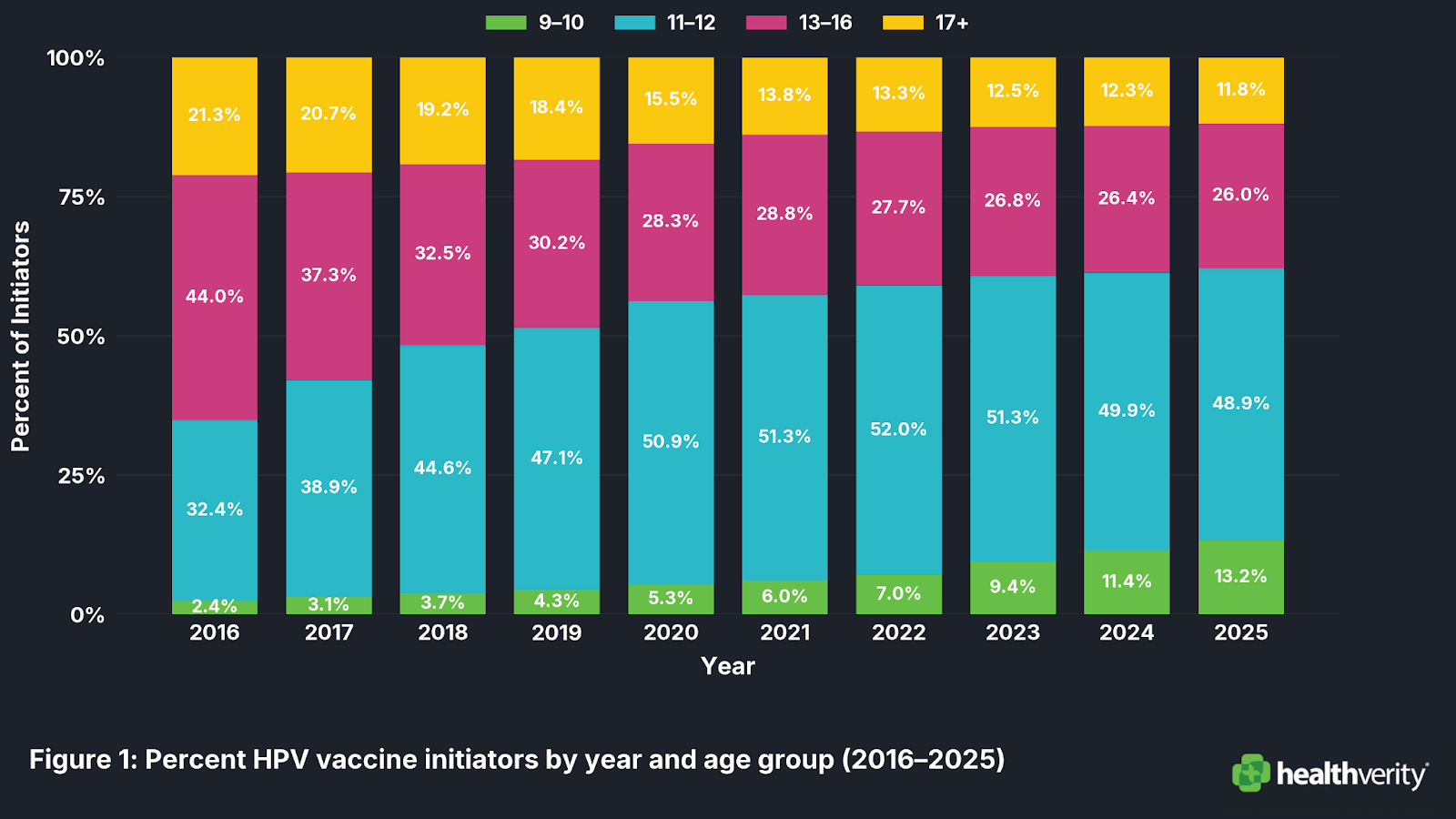
**Figure 1:** Percentage of HPV vaccine initiators by age group (2016–2025).
## Gender gaps narrowing in HPV vaccination
HPV vaccination was initially recommended only for females and later expanded to include males in 2011. In our closed claims population, initiation patterns between males and females have been broadly similar since 2016.
Figure 2 shows that females consistently account for a slight majority of initiators (approximately 51%), with males comprising about 49%. These proportions have remained relatively stable over time since 2016.
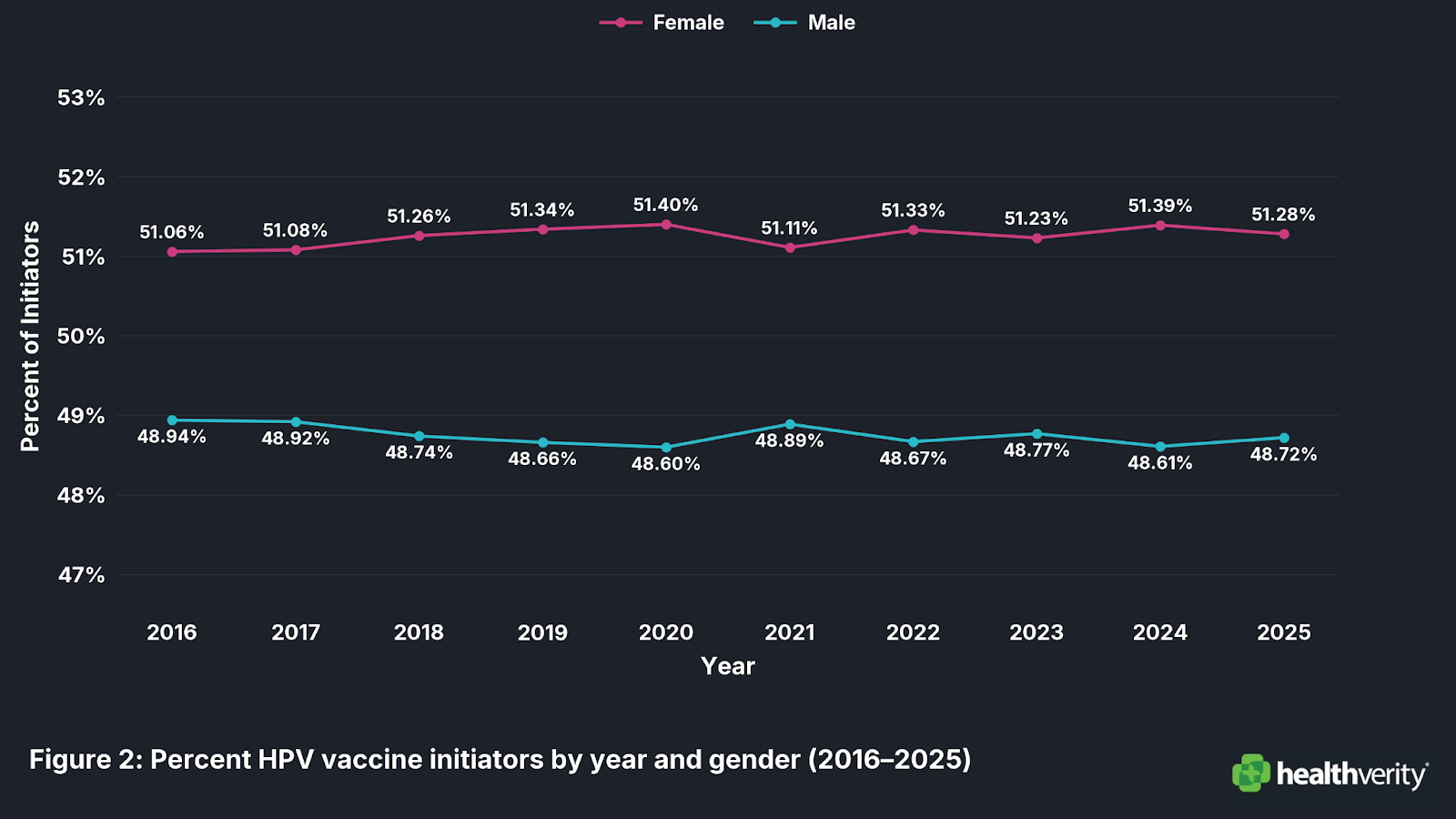
**Figure 2:** Percentage of HPV Vaccine Initiators by Gender and Year (2016–2025).
Across most age groups, the difference between male and female initiators is modest, typically within 1–2 percentage points. However, among patients aged ≥17 years, females represent a somewhat higher share of initiators relative to younger age groups. This pattern may reflect historical female-focused recommendations, as well as more frequent preventative reproductive health visits among adolescent girls and young women.
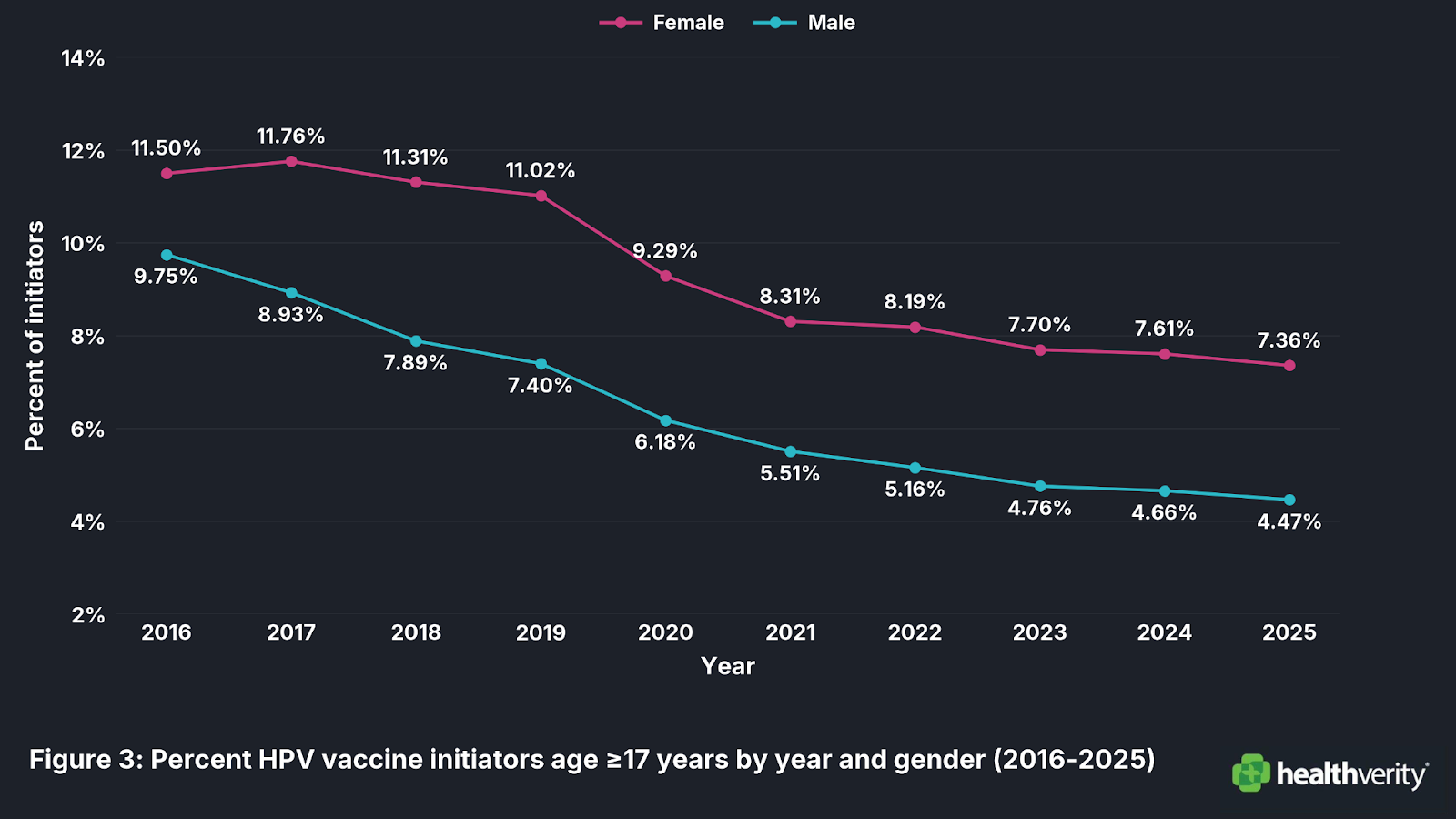
**Figure 3:** Percentage of HPV Vaccine Initiators by Gender Among Patients Aged ≥17 Years.
Overall, these trends suggest that HPV vaccine initiation is largely comparable between males and females in recent years, although modest differences remain.
## HPV vaccination coverage remains a public health challenge
Healthy People 2030, led by the U.S. Department of Health and Human Services, sets measurable national objectives to improve population health and reduce disparities. One objective is to increase the percentage of adolescents aged 13–15 who received the recommended doses of the HPV to 80% by 2030, from a baseline of 48.0% in 2018.8
CDC guidelines9 recommend:
- A two-dose series for individuals initiating vaccination at ages 9–14
- A three-dose series for those initiating at age 15 or older
To evaluate HPV vaccination coverage, we examined adolescents aged 13–15 in 2024 with continuous medical and pharmacy insurance enrollment from the year they turned age 9 through the end of 2024 (Figure 4). Continuous enrollment was required to ensure comprehensive capture of vaccination history. These estimates reflect a population with a mix of commercial and Medicaid coverage.
Overall:
- 65% initiated the HPV vaccine series
- 47% completed the recommended series, according to CDC guidelines
Figure 4 presents initiation and completion rates by race and ethnicity.
Among racial groups:
- Asian adolescents had the highest initiation (72%) and completion (54%) rates
- Black adolescents and those categorized as “Other” race demonstrated higher coverage, with initiation and completion rates of 70% and 47%, and 69% and 51%, respectively
- White adolescents had the lowest initiation (63%) and completion (45%) rates
By ethnicity:
- Hispanic adolescents showed higher initiation (75%) and completion (55%) rates
- Non-Hispanic adolescents had lower initiation (62%) and completion (44%) rates
These patterns are broadly consistent with findings from CDC’s National Immunization Survey–Teen (NIS-Teen), which has reported higher HPV vaccination coverage among Hispanic adolescents and some non-White racial groups compared to non-Hispanic White adolescents.10Reasons for these differences are likely multifactorial, and may reflect differences in insurance payer type, access to vaccination programs, and provider recommendation patterns.
HPV series completion remains lower than initiation rates across all groups, underscoring the need for public health programs and provider efforts to ensure adolescents receive all recommended doses of the vaccine.
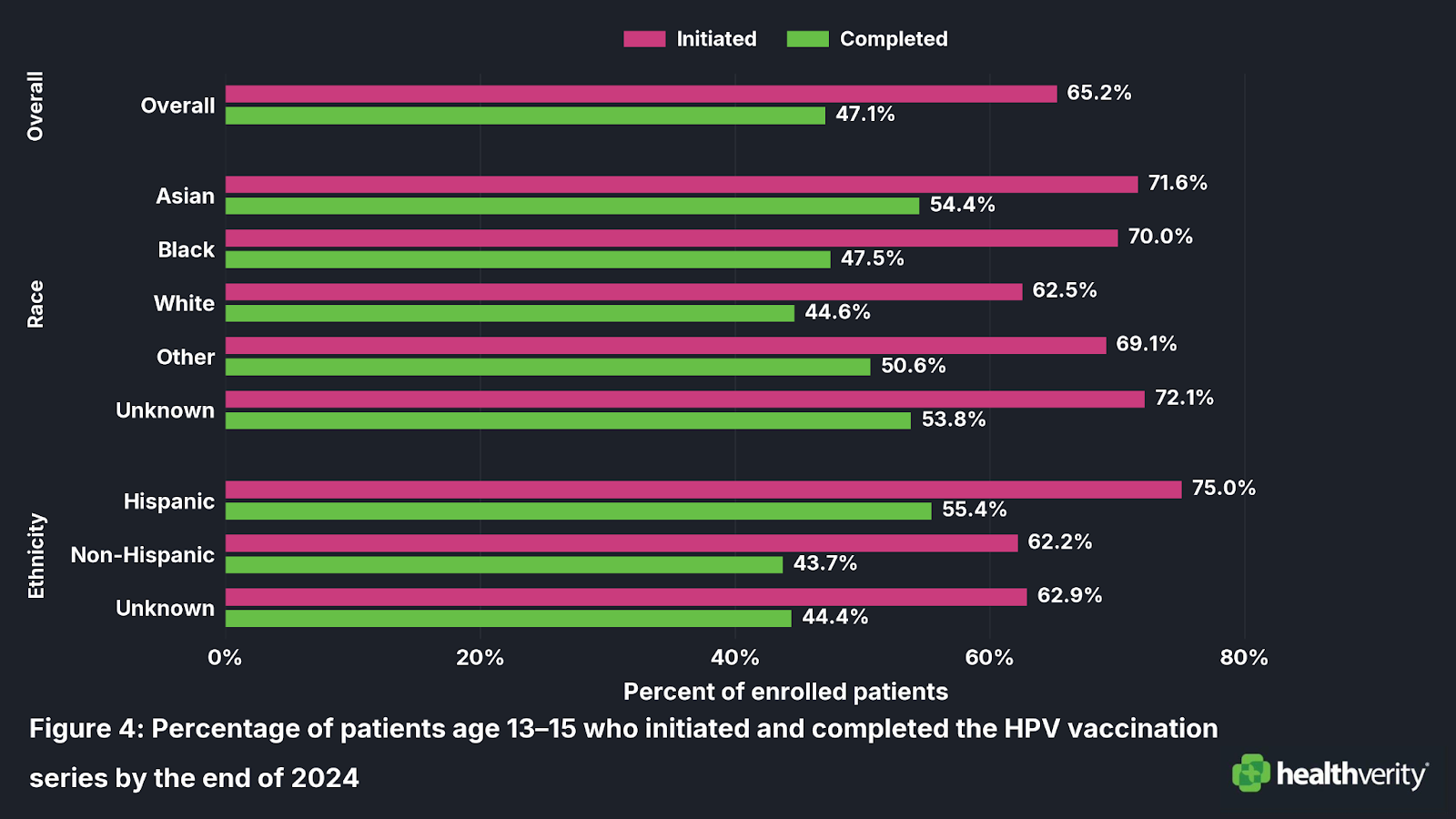
Figure 4: HPV Vaccination Initiation and Completion Among Adolescents Aged 13–15 by Race and Ethnicity, 2024.
## Vaccine coverage measurement considerations for public health
Claims data may not capture vaccinations administered outside billable medical or pharmacy settings. Continuous enrollment criteria improve comprehensive vaccination capture but may bias the cohort toward individuals with stable insurance coverage. Despite these limitations, longitudinal claims data provide detailed insight into vaccination timing and adherence patterns at scale.
## Translating real-world data insights into impact
While initiation trends show encouraging movement toward vaccination at recommended ages and gender gaps appear to be narrowing, completion rates remain below national targets. HPV vaccination coverage remains lower than coverage for other routine adolescent vaccines, such as Tdap and MenACWY.10 On International HPV Awareness Day and beyond, promoting timely vaccination remains critical to preventing HPV-related cancers.
## The value of real-world evidence in HPV vaccination
Understanding vaccine initiation and completion patterns requires more than cross-sectional survey data. Longitudinal claims data enable precise measurement of vaccination timing and verification of series completion. These findings highlight how real-world data can support ongoing monitoring of vaccine coverage, identify gaps, and inform evidence-based public health strategies to advance cancer prevention.
[](https://blog.healthverity.com/hs/cta/wi/redirect?encryptedPayload=AVxigLIVYJDe5HEQ3JJA%2FtxoUwRvQj4MFVkoC7jsNmr07p7VWjCaCnl6MLCKDWwIL0fTztpGAjJw%2FE7BwpbjqGUz%2F9z23zJdlFJmA6b9T7h0fAOYoto9vAa1OS5Q7Hjf0XaS1i3dl3JV9kkGgsLHN0jpSfPY6EsDaLQORmlt1RG7q4V6izofNaRjPJZZ0yzkoPnWBVehtMqBQHi3&webInteractiveContentId=196135223637&portalId=5412465)
## References
1. National Cancer Institute. HPV and cancer.[https://www.cancer.gov/about-cancer/causes-prevention/risk/infectious-agents/hpv-and-cancer](https://www.cancer.gov/about-cancer/causes-prevention/risk/infectious-agents/hpv-and-cancer)
2. Centers for Disease Control and Prevention. Cervical cancer statistics.[https://www.cdc.gov/cervical-cancer/statistics/index.html](https://www.cdc.gov/cervical-cancer/statistics/index.html)
3. World Health Organization. Cervical cancer.[https://www.who.int/news-room/fact-sheets/detail/cervical-cancer](https://www.who.int/news-room/fact-sheets/detail/cervical-cancer)
4. Markowitz LE, Gee J, Chesson H, Stokley S. Ten Years of Human Papillomavirus Vaccination in the United States. Acad Pediatr. 2018. [https://pmc.ncbi.nlm.nih.gov/articles/PMC11331487/](https://pmc.ncbi.nlm.nih.gov/articles/PMC11331487/)
5. Saxena K, Kathe N, Sardana P, Yao L, Chen YT, Brewer NT. HPV vaccine initiation at 9 or 10 years of age and better series completion by age 13 among privately and publicly insured children in the US. Hum Vaccin Immunother. 2023 Dec 31. [https://pmc.ncbi.nlm.nih.gov/articles/PMC9980633/](https://pmc.ncbi.nlm.nih.gov/articles/PMC9980633/)
6. Centers for Disease Control and Prevention. HPV vaccine safety and effectiveness data.[https://www.cdc.gov/hpv/hcp/vaccination-considerations/safety-and-effectiveness-data.html](https://www.cdc.gov/hpv/hcp/vaccination-considerations/safety-and-effectiveness-data.html?utm_source=chatgpt.com)
7. American Cancer Society. Declines in cervical cancer following HPV vaccine introduction.[https://pressroom.cancer.org/declines-in-cervical-cancer-hpv-vaccine](https://pressroom.cancer.org/declines-in-cervical-cancer-hpv-vaccine).
8. Office of Disease Prevention and Health Promotion. Increase the proportion of adolescents who get recommended doses of the HPV vaccine (IID-08).[https://odphp.health.gov/healthypeople/objectives-and-data/browse-objectives/vaccination/increase-proportion-adolescents-who-get-recommended-doses-hpv-vaccine-iid-08](https://odphp.health.gov/healthypeople/objectives-and-data/browse-objectives/vaccination/increase-proportion-adolescents-who-get-recommended-doses-hpv-vaccine-iid-08)
9. Centers for Disease Control and Prevention. HPV vaccination recommendations.[https://www.cdc.gov/hpv/hcp/vaccination-considerations/index.html](https://www.cdc.gov/hpv/hcp/vaccination-considerations/index.html)
10. Pingali C. HPV vaccination coverage among adolescents (NIS-Teen) \[ACIP presentation\].[https://www.cdc.gov/acip/downloads/slides-2025-04-15-16/04-Pingali-HPV-508.pdf](https://www.cdc.gov/acip/downloads/slides-2025-04-15-16/04-Pingali-HPV-508.pdf?utm_source=chatgpt.com)
[](https://blog.healthverity.com/hs/cta/wi/redirect?encryptedPayload=AVxigLKzCq066Ngxx9uTN8srXRX7UzAyFlFYH2pT%2Fa9qKq2i9MoRQWEavc1lQIvYKSh1UQ7HAkrwVibG32ADJ9INDHGO%2FGh7Aiya%2B%2FDUkWBngtavS4PEqXXDq85RhUAShStsW8AZJPCQlqc%2Fji7WvfPPXRCz6x5B09gSSceFfD5RXlsjma%2FwL4el%2B%2F1xrBRJu8OyW1m4SvrLfO%2F%2FBSP0&webInteractiveContentId=195733501532&portalId=5412465)
###### Category
- [Solutions & Best Practices](https://blog.healthverity.com/tag/solutions-best-practices)
- [Trends & Insights](https://blog.healthverity.com/tag/trends-insights)
- [HEOR](https://blog.healthverity.com/tag/heor)
- [Marketplace (RWD)](https://blog.healthverity.com/tag/marketplace-rwd)
- [Thought Leadership](https://blog.healthverity.com/tag/thought-leadership)
- [Industry Updates](https://blog.healthverity.com/tag/industry-updates)
- [Open & Closed Claims](https://blog.healthverity.com/tag/open-closed-claims)
- [Case Studies](https://blog.healthverity.com/tag/case-studies)
- [Commercial Pharma](https://blog.healthverity.com/tag/commercial-pharma)
- [Government](https://blog.healthverity.com/tag/government)
- [AI](https://blog.healthverity.com/tag/ai)
- [eXOs](https://blog.healthverity.com/tag/exos)
- [Audiences](https://blog.healthverity.com/tag/audiences)
- [taXonomy Pathways](https://blog.healthverity.com/tag/taxonomy-pathways)
- [Clinical Notes](https://blog.healthverity.com/tag/clinical-notes)
- [Rare Diseases](https://blog.healthverity.com/tag/rare-diseases)
###### Popular Post
- [The GLP-1 trend: What the real-world data reveals](https://blog.healthverity.com/the-glp-1-surge-what-the-real-world-data-reveals)
- [GLP-1 trends 2025: real-world data, patient outcomes & future therapies](https://blog.healthverity.com/glp-1-trends-2025-real-world-data-patient-outcomes-future-therapies)
- [Open claims vs. closed payer claims: What’s the difference?](https://blog.healthverity.com/open-claims-vs-closed-payer-claims)
- [An integrated approach for deeper insight with both open and closed claims data](https://blog.healthverity.com/an-integrated-approach-for-deeper-insight-with-both-open-and-closed-claims-data)
- [GLP‑1 real‑world data for obesity: A new standard for metabolic care](https://blog.healthverity.com/glp-1-real-world-data-for-obesity-a-new-standard-for-metabolic-care)
###### Subscribe
### Similar Blogs
[](https://blog.healthverity.com/why-underpowered-studies-are-more-dangerous-than-you-think)
#### [Why underpowered studies are more dangerous than you think](https://blog.healthverity.com/why-underpowered-studies-are-more-dangerous-than-you-think)
By [HealthVerity](https://blog.healthverity.com/author/healthverity) 20 May 2026
In epidemiology, statistical power determines whether a study can accurately detect an effect of a...
[READ MORE](https://blog.healthverity.com/hpv-vaccination-trends-from-2016-to-2025)
[](https://blog.healthverity.com/understanding-the-breast-cancer-patient-journey-in-2025)
#### [Understanding the breast cancer patient journey in 2025](https://blog.healthverity.com/understanding-the-breast-cancer-patient-journey-in-2025)
By [HealthVerity](https://blog.healthverity.com/author/healthverity) 29 October 2025
October is Breast Cancer Awareness Month. While pink ribbons and fundraising campaigns help bring...
[READ MORE](https://blog.healthverity.com/hpv-vaccination-trends-from-2016-to-2025)
[](https://blog.healthverity.com/insights-from-impacct-2025-advancing-real-world-evidence)
#### [Insights from IMPACCT 2025: advancing real-world evidence](https://blog.healthverity.com/insights-from-impacct-2025-advancing-real-world-evidence)
By [HealthVerity](https://blog.healthverity.com/author/healthverity) 4 November 2025
Identifying the gaps in today’s real-world data The 2025 IMPACCT Real-World Evidence Summit brought...
[READ MORE](https://blog.healthverity.com/hpv-vaccination-trends-from-2016-to-2025)
#### Who we serve
- [Life Sciences](https://healthverity.com/life-sciences/)
- [Government](https://healthverity.com/government/)
- [Insurance](https://healthverity.com/insurance/)
- [Channel Partners](https://healthverity.com/channel-partners/)
- [Data Ecosystem Partners](https://healthverity.com/data-ecosystem-partners/)
#### How we help
- [HealthVerity Marketplace](https://healthverity.com/marketplace/)
- [HealthVerity Mastersets](https://healthverity.com/mastersets/)
- [HealthVerity FLOW](https://healthverity.com/flow/)
- [The IPGE Approach](https://healthverity.com/ipge-approach/)
#### Resources
- [HealthVerity Blog](https://blog.healthverity.com/)
- [News & Events](https://healthverity.com/resources/news-and-events/)
- [Resource Library](https://healthverity.com/resources/resource-library/)
- [Publications](https://healthverity.com/resources/publications/)
#### Our company
- [About Us](https://healthverity.com/about-us/)
- [Leadership](https://healthverity.com/about-us/#leadership)
- [Board of Directors](https://healthverity.com/about-us/#board)
- [Careers](https://healthverity.com/careers/)
- [Contact](https://healthverity.com/contact/)
©2026 HealthVerity, Inc. | [Terms & Conditions](https://healthverity.com/terms-and-conditions/) | [Privacy Policy](https://healthverity.com/privacy-policy/)
```json
{
"@context" : "https://schema.org",
"@type" : "BlogPosting",
"author" : {
"@type" : "Person",
"name" : "Alexandra Miller, MPH"
},
"datePublished" : "2026-03-04",
"description" : "An analysis of real-world claims data reveals shifting trends in HPV vaccine initiation and completion from 2016 to 2025, highlighting narrowing gender gaps and demographic disparities.",
"headline" : "HPV vaccination trends from 2016 to 2025: Progress and missed opportunities",
"keywords" : [ "HPV vaccination trends", "HPV vaccine initiation", "Gardasil", "real-world data", "claims data analysis", "cervical cancer prevention", "vaccination demographics", "healthcare analytics", "CDC guidelines" ],
"mainEntityOfPage" : {
"@id" : "https://blog.healthverity.com/hpv-vaccination-trends-from-2016-to-2025",
"@type" : "WebPage"
},
"publisher" : {
"@type" : "Organization",
"logo" : {
"@type" : "ImageObject",
"url" : "https://healthverity.com/wp-content/uploads/2023/08/healthverity-logo.png"
},
"name" : "HealthVerity"
}
}
```
```json
{
"@context" : "https://schema.org",
"@type" : "FAQPage",
"mainEntity" : [ {
"@type" : "Question",
"acceptedAnswer" : {
"@type" : "Answer",
"text" : "Based on closed claims data, the proportion of HPV vaccine initiators in the recommended 11–12 age group increased substantially, from approximately 32% in 2016 to nearly 49% in 2025. This reflects growing alignment with clinical guidance that emphasizes pre-exposure protection."
},
"name" : "What age group is initiating the HPV vaccine the most?"
}, {
"@type" : "Question",
"acceptedAnswer" : {
"@type" : "Answer",
"text" : "The gender gap in HPV vaccination is narrowing. While initially recommended only for females, initiation patterns have been broadly similar since 2016, with females accounting for approximately 51% of initiators and males comprising about 49%."
},
"name" : "Is there a gender gap in HPV vaccination rates?"
}, {
"@type" : "Question",
"acceptedAnswer" : {
"@type" : "Answer",
"text" : "While 65% of individuals initiated the HPV vaccine series, only 47% completed the recommended series according to CDC guidelines. This completion rate remains below national targets and lower than coverage for other routine adolescent vaccines like Tdap and MenACWY."
},
"name" : "What percentage of patients complete the recommended HPV vaccine series?"
}, {
"@type" : "Question",
"acceptedAnswer" : {
"@type" : "Answer",
"text" : "Data reveals demographic disparities in HPV vaccination. Asian adolescents had the highest initiation (72%) and completion (54%) rates, while White adolescents had the lowest (63% initiation, 45% completion). Additionally, Hispanic adolescents showed higher rates of initiation (75%) compared to non-Hispanic adolescents (62%)."
},
"name" : "How do HPV vaccination rates vary by race and ethnicity?"
}, {
"@type" : "Question",
"acceptedAnswer" : {
"@type" : "Answer",
"text" : "Longitudinal claims data allows for precise measurement of vaccination timing and verifies series completion over time. This offers a much more accurate view than cross-sectional survey data, helping public health officials monitor coverage, identify gaps, and advance cancer prevention strategies."
},
"name" : "Why is real-world data important for tracking HPV vaccination?"
} ]
}
```
```json
{
"@context" : "https://schema.org",
"@type" : "BreadcrumbList",
"itemListElement" : [ {
"@type" : "ListItem",
"item" : "https://healthverity.com/",
"name" : "Home",
"position" : 1
}, {
"@type" : "ListItem",
"item" : "https://blog.healthverity.com/",
"name" : "Blog",
"position" : 2
}, {
"@type" : "ListItem",
"item" : "https://blog.healthverity.com/hpv-vaccination-trends-from-2016-to-2025",
"name" : "HPV vaccination trends from 2016 to 2025: Progress and missed opportunities",
"position" : 3
} ]
}
```
```json
{
"@context" : "https://schema.org",
"@type" : "BlogPosting",
"articleSection" : [ "Thought Leadership", "Trends & Insights" ],
"author" : {
"@type" : "Person",
"name" : "Alexandra Miller, MPH"
},
"dateModified" : "2026-03-04",
"datePublished" : "2026-03-04",
"description" : "Using longitudinal closed medical and pharmacy claims data, this article examines real-world HPV vaccine initiation and completion trends from 2016–2025 among patients ages 9–26, including shifts toward recommended vaccination ages, narrowing gender gaps, and 2024 initiation/completion rates by race and ethnicity compared with public health targets.",
"headline" : "HPV vaccination trends from 2016 to 2025: Progress and missed opportunities",
"image" : [ "https://blog.healthverity.com/hubfs/hpv-vaccination-trends-featured-1.png" ],
"inLanguage" : "en-US",
"keywords" : [ "HPV", "HPV vaccine", "HPV vaccination", "Gardasil", "vaccine initiation", "vaccine completion", "real-world data", "claims data", "Healthy People 2030", "CDC guidelines", "vaccination coverage", "public health" ],
"mainEntityOfPage" : {
"@id" : "https://blog.healthverity.com/hpv-vaccination-trends-from-2016-to-2025",
"@type" : "WebPage"
},
"publisher" : {
"@type" : "Organization",
"logo" : {
"@type" : "ImageObject",
"url" : "https://healthverity.com/wp-content/uploads/healthverity-2023-logo2x.png"
},
"name" : "HealthVerity"
}
}
```
```json
{
"@context" : "https://schema.org",
"@type" : "FAQPage",
"mainEntity" : [ {
"@type" : "Question",
"acceptedAnswer" : {
"@type" : "Answer",
"text" : "Human papillomavirus (HPV) is a very common sexually transmitted infection. While many infections resolve on their own, persistent infection with high-risk HPV types can lead to cervical cancer and other malignancies. Vaccination helps prevent many HPV-related cancers when given before exposure."
},
"name" : "What is HPV and why is vaccination important?"
}, {
"@type" : "Question",
"acceptedAnswer" : {
"@type" : "Answer",
"text" : "HPV vaccination is recommended for girls and boys beginning at age 9, with routine vaccination ideally at ages 11–12. Catch-up vaccination is recommended through age 26."
},
"name" : "When is the HPV vaccine recommended?"
}, {
"@type" : "Question",
"acceptedAnswer" : {
"@type" : "Answer",
"text" : "Across 2016–2025, a growing share of new initiators occurred in the recommended 11–12 age group, while initiation among older adolescents and young adults declined as a share of total initiators—suggesting improved alignment with clinical guidance emphasizing earlier vaccination."
},
"name" : "What did the 2016–2025 claims analysis show about vaccination age trends?"
}, {
"@type" : "Question",
"acceptedAnswer" : {
"@type" : "Answer",
"text" : "Initiation rates are higher than completion rates. In the article’s continuously enrolled 13–15-year-old cohort (through 2024), about 65% initiated the series while about 47% completed the recommended series, indicating drop-off between starting and finishing recommended doses."
},
"name" : "How do HPV vaccination initiation and completion differ in adolescents?"
}, {
"@type" : "Question",
"acceptedAnswer" : {
"@type" : "Answer",
"text" : "Claims data may miss vaccinations given outside billable medical or pharmacy settings. Requiring continuous enrollment improves capture of vaccination history but can bias toward people with stable insurance coverage. Even with these limitations, longitudinal claims can provide detailed insight into vaccination timing and series completion at scale."
},
"name" : "What are key limitations of measuring HPV vaccination using claims data?"
} ]
}
```
```json
{
"@context" : "https://schema.org",
"@type" : "BreadcrumbList",
"itemListElement" : [ {
"@type" : "ListItem",
"item" : "https://blog.healthverity.com/",
"name" : "Home",
"position" : 1
}, {
"@type" : "ListItem",
"item" : "https://blog.healthverity.com/",
"name" : "HealthVerity Blog",
"position" : 2
}, {
"@type" : "ListItem",
"item" : "https://blog.healthverity.com/hpv-vaccination-trends-from-2016-to-2025",
"name" : "HPV vaccination trends from 2016 to 2025: Progress and missed opportunities",
"position" : 3
} ]
}
```