
Know what closed payer claims can reveal about patient journeys, treatment persistence and the commercial opportunities behind the data
A patient starts therapy. But what happens next? Do they persist, switch or discontinue? For commercial teams, understanding what happens after treatment initiation can be just as important as knowing how many patients started.
Closed claims data consists of adjudicated medical and pharmacy claims from health insurers, with enrollment information that helps establish when patients were covered and observable. Closed claims data has long been a staple of real-world evidence (RWE) and health economics and outcomes research (HEOR), supporting longitudinal patient studies, treatment persistence and healthcare utilization analyses.
Symphony Health’s commercial data now pairs with HealthVerity’s medical, pharmacy and clinical data, helping brands examine treatment journeys, patient retention and growth opportunities. Unlike open claims, closed claims include enrollment information that helps establish when patients were observable, providing important context for interpreting treatment gaps and healthcare utilization.
The question isn't simply how much treatment activity you can see. It's knowing what happens throughout the observable patient journey, and what that means for your brand.
Picking the right approach for a commercial or research question starts with knowing what closed claims can tell you, and when you’ll need another source to fill in the rest.
What are the benefits of closed claims data?
Closed claims provide a structured, enrollment-based view of healthcare activity that can support both commercial decision-making and rigorous evidence generation.
Four benefits are particularly relevant to commercial teams.
1. Treatment persistence: Know what happens after therapy initiation
Are patients leaving your brand, or are you missing part of their treatment journey?
For many pharmaceutical brands, growth depends on more than acquiring new patients. It also depends on understanding what happens after patients initiate treatment.
Closed claims allow teams to examine observed pharmacy and medical activity across defined enrollment periods, supporting analyses of:
- Treatment initiation and subsequent utilization
- Medication adherence and persistence
- Treatment gaps and discontinuation
- Switching between therapies
- Treatment sequencing and duration
- Healthcare utilization before and after treatment changes
Enrollment information helps establish whether patients remained observable during the study period, reducing uncertainty about whether an apparent gap in treatment reflects missing data.
For commercial teams, these insights can help distinguish patient acquisition challenges from retention challenges and identify opportunities for more targeted patient support strategies.
What could a different view of treatment persistence reveal?
In a HealthVerity analysis* comparing open and closed claims among patients treated with GLP-1 and SGLT2 therapies for type 2 diabetes, researchers observed differences in treatment persistence measures across the two datasets.
Among patients receiving GLP-1 therapies 55.0% of patients in the closed claims cohort achieved at least 80% proportion of days covered (PDC), compared with 48.4% in the open claims cohort. 38.3% of patients in the closed claims cohort discontinued treatment, compared with 43.2% in the open claims cohort (Figure 1).
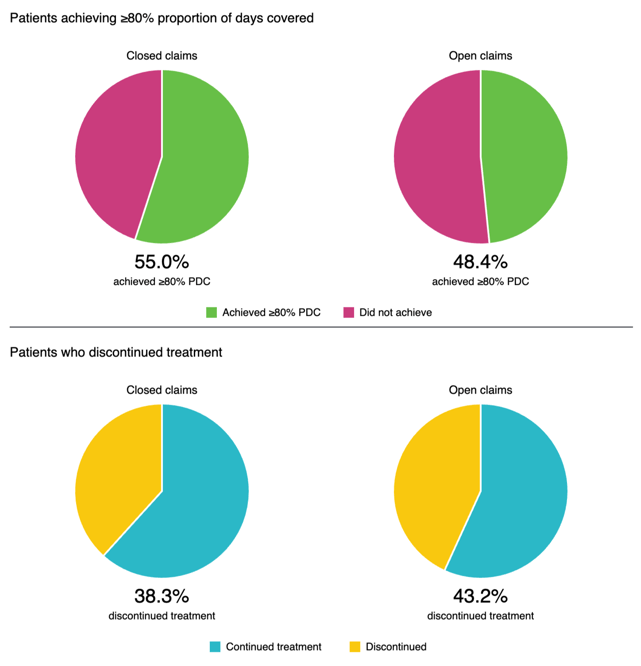
Figure 1: GLP-1 therapy outcomes in closed claims vs. open claims data. PDC = proportion of days covered. Both differences between the closed and open claims cohorts were statistically significant (two-proportion z-test, p<0.001).
These differences illustrate why data selection, capture and observation requirements matter when evaluating treatment continuity.
For commercial teams, understanding those differences can influence how they interpret patient retention, assess treatment patterns and investigate opportunities for patient support.
2. Patient journeys and healthcare utilization: Understand what happens across care settings
What happens to patients beyond the treatment you’re tracking and what does it mean for your brand?
A prescription or treatment event represents one moment in a patient’s healthcare experience. Before and after that event, patients interact with multiple providers, undergo diagnostic procedures, receive additional therapies and may require hospital-based care — each generating observable activity and associated costs.
Closed claims help teams examine covered medical and pharmacy activity over time, providing context for understanding:
- Healthcare encounters before and after diagnosis or treatment initiation
- Comorbidities and coexisting conditions
- Diagnostic and treatment pathways
- Physician, specialist and facility encounters
- Inpatient, outpatient, emergency department and other healthcare services
- Claims-based costs associated with observed services and treatments, where available
For commercial teams, enrollment-based patient histories can support analyses of diagnosed populations, disease burden and observed incidence or prevalence within defined insured cohorts. These insights help brands characterize addressable patient populations, understand comorbidity patterns, segment patients by treatment and utilization profiles, and inform market assessments or pre-launch planning.
For rare disease brands, where identifying and characterizing patients can be particularly challenging, that longitudinal context may reveal opportunities that prescription activity alone does not capture.
Knowing which patients receive treatment is valuable. Understanding the healthcare activity and costs surrounding that treatment can reveal a different set of opportunities.
3. Enrollment visibility: Distinguish treatment gaps from gaps in observation
If a patient disappears from your data, did they stop treatment, or did you stop seeing them? This is one of the most important distinctions between open and closed claims.
Open claims aggregate activity from multiple sources, providing broad visibility into healthcare encounters. The absence of a claim does not necessarily establish that a patient did not receive care.
Closed claims include enrollment information that establishes when a patient was covered and eligible to have healthcare activity observed within the contributing plan’s data. That observability window is what lets researchers interpret missing claims correctly, supporting analyses that depend on knowing whether a patient could have been seen:
- Confirming a patient was observable before and after treatment initiation
- Separating true discontinuation from a change in coverage
- Measuring adherence and persistence over a defined follow-up window
- Building longitudinal cohorts with known observation periods
Consider a brand investigating why patients appear to discontinue therapy six months after initiation. Without enrollment information, an apparent treatment gap could reflect actual discontinuation, incomplete data capture or a change in insurance coverage. Closed claims can establish whether a patient remained enrolled during the relevant observation period, providing greater confidence when evaluating treatment continuity and patient retention.
Enrollment doesn’t guarantee every relevant service is captured. Closed claims will miss fills paid for through patient assistance programs, cash transactions never submitted to insurance, and care delivered through non-profit or community health settings that don’t route through the payer. Medical and pharmacy benefits may also differ, and visibility can be affected by benefit carve-outs.
The value isn’t simply seeing more claims. It’s knowing when the patient was observable so you can interpret what you see more confidently.
How does closed claims data work?
Closed claims data consists of adjudicated healthcare claims collected from health insurers or health plans.
These datasets typically include medical and pharmacy claims associated with covered individuals, along with enrollment information that establishes when patients were eligible for benefits within the contributing insurance population.
Closed claims can include information about:
- Medical diagnoses and procedures
- Physician and facility encounters
- Prescription dispensing activity
- Inpatient and outpatient services
- Dates of healthcare services
- Enrollment and coverage periods
- Adjudicated financial information, where available
Because the information comes from an insurer's adjudicated claims activity, closed claims generally offer more consistent observation of covered healthcare services during a patient's enrollment period than a source that captures only selected transactions.
However, closed claims are not necessarily representative of the entire healthcare market, and patient observation may be interrupted when coverage changes.
Open and closed claims offer different perspectives on healthcare activity, each with distinct advantages depending on the question being asked. Understanding those differences can help commercial and research teams determine which datasets are best suited to their needs.
For a deeper look at the benefits, limitations and applications of open claims, explore our guide to open claims data.
Open claims vs. closed claims: What's the difference?
|
Dimension |
Open claims |
Closed claims |
|
Primary sources |
Clearinghouses, pharmacies, pharmacy benefit managers and other transaction sources |
Health insurers and health plans |
|
Timeliness |
Generally more timely |
Generally subject to adjudication and reporting lag |
|
Population visibility |
Broad coverage across multiple sources and payment types |
Defined insured populations represented by contributing plans |
|
Enrollment information |
Generally unavailable |
Available for covered populations, subject to dataset limitations |
|
Longitudinal analysis |
Requires activity-based stability or other observation criteria |
Supports enrollment-defined observation periods |
|
Provider visibility |
Often broader across contributing sources |
Limited to activity associated with covered members |
|
Payer intelligence |
Can support payer-level analyses when appropriate payer identification or access data is available |
Specific payer identities may be masked; not necessarily suitable for named-payer analyses |
|
Common applications |
Market sizing, HCP targeting, launch planning, early market trends and broader patient identification |
Treatment persistence, longitudinal patient journeys, healthcare utilization and outcomes research |
|
Key considerations |
Incomplete capture and changing source coverage |
Reporting lag, enrollment boundaries and population representativeness |
Neither dataset tells the whole story.
The right choice depends on the question being asked, the population being studied and the level of longitudinal observation required.
What are the most common commercial use cases for closed claims data?
Although closed claims are widely used in RWE and HEOR, their applications extend across commercial planning, brand performance and lifecycle management.
|
Commercial use case |
What closed claims can help answer |
|
Patient journey mapping |
What healthcare activity occurs before diagnosis, treatment initiation or a change in therapy? |
|
Treatment persistence and adherence |
How long do patients remain on therapy, and where do observed gaps occur? |
|
Treatment switching and sequencing |
Which therapies are observed before or after a particular treatment? |
|
Brand performance and patient retention |
Are observed changes in utilization associated with initiation, persistence, switching or discontinuation? |
|
Patient segmentation |
How do treatment patterns vary among patients with different comorbidities, care histories or utilization profiles? |
|
Specialty and limited-distribution therapies |
What covered treatment activity is observable when other transaction sources have limited visibility? |
|
Healthcare resource utilization |
What inpatient, outpatient and other healthcare services are observed before and after treatment? |
|
Pre-launch and lifecycle planning |
What can historical treatment pathways reveal about the current standard of care and potential patient needs? |
Consider a specialty brand experiencing slower-than-expected growth.
What if the market is bigger than your data suggests?
For specialty and limited-distribution therapies, slower-than-expected growth may not tell the whole story. When treatment activity is underrepresented in open pharmacy claims, commercial teams risk underestimating their addressable patient population, overlooking treating HCPs and making decisions based on an incomplete view of the market.
In an illustrative HealthVerity analysis of a limited-distribution specialty oral therapy, adding closed claims to an open pharmacy claims baseline revealed approximately 194 times more patients and 150 times more treating HCPs than the original view captured (Figure 2).
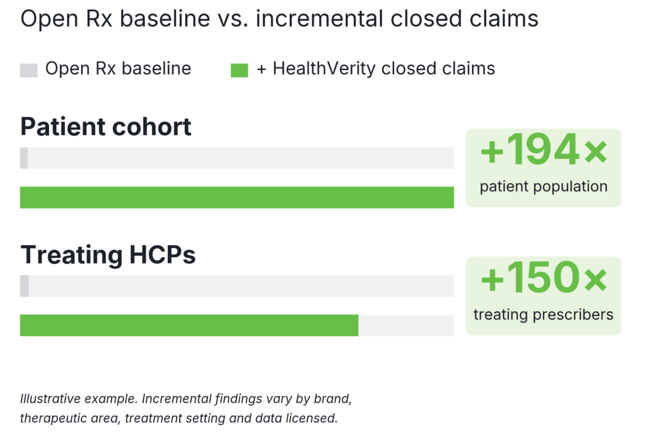
Figure 2: Market visibility shift when using open claims and closed claims
That additional visibility can change the commercial question from “How do we drive more prescriptions?” to “How much of our market are we actually seeing?”
And identifying the market is only the beginning. With enrollment-based observation periods, closed claims can also help teams investigate treatment initiation, persistence, switching and associated healthcare utilization among covered patients.
For commercial teams, these insights can inform market assessments, HCP prioritization and brand strategy. For RWE and HEOR teams, the same data can support longitudinal treatment-pattern and healthcare utilization analyses.
What are the limitations of closed claims data?
Closed claims offer important advantages, but understanding their limitations is essential to choosing an appropriate dataset and interpreting results.
1. Reporting lag
Because closed claims typically undergo adjudication and processing before becoming available, they generally have a longer reporting lag than open claims.
This can limit their suitability for questions requiring rapid visibility into recent market activity, prescribing changes or launch performance. For early market signals and near-term commercial monitoring, open claims may be more appropriate.
2. Enrollment boundaries and payer switching
Closed claims provide visibility during a patient’s enrollment period within the contributing insurance population.
When a patient changes insurers or leaves the represented coverage population, longitudinal observation may end — unless the patient is captured through another payer source in the closed claims ecosystem. Medical and pharmacy benefit enrollment may also differ.
Researchers must account for these boundaries when defining observation windows and interpreting treatment gaps (Figure 3).
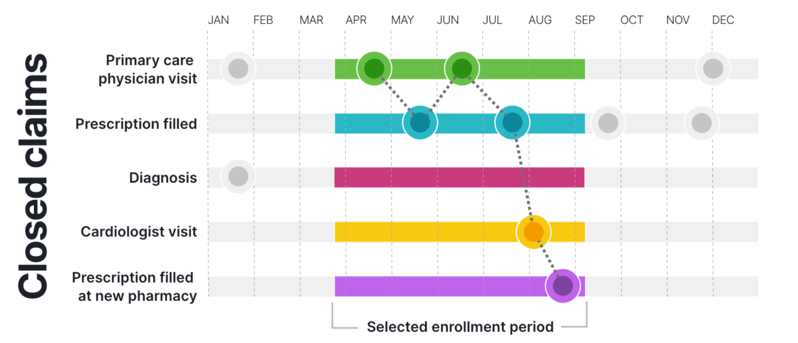
Figure 3: example of patient visibility in closed claims data for a selected enrollment period with a specific payer.
3. Population representativeness
Closed claims reflect the insured populations included in the contributing plans.
The distribution of Commercial, Managed Medicare and Managed Medicaid beneficiaries may differ from the broader U.S. population or a specific therapeutic market. Fee-for-service Medicare and Medicaid populations are often less well represented.
This matters when estimating market size, evaluating rare populations or generalizing findings. Analysts should assess dataset composition and apply appropriate methods to address potential selection bias.
4. Limited clinical detail
Claims are generated primarily for administrative and reimbursement purposes, not to document every aspect of a patient’s clinical condition. Although diagnosis, procedure and treatment information can be highly valuable, claims may not capture:
- Disease severity or stage
- Laboratory results and biomarkers
- Clinical observations and physician notes
- Treatment rationale
- Patient-reported outcomes
- Reasons for discontinuation or switching
These questions may require linked laboratory, electronic health record, clinical notes or other complementary datasets.
5. Limited payer and access interpretation
Closed claims can document covered healthcare activity, but they do not necessarily identify the specific payer or explain why a treatment was approved, denied, delayed or changed. In some datasets, payer identities are intentionally masked to protect contributing suppliers.
For commercial market access analyses involving named payers, formulary restrictions, benefit design, prior authorization or reimbursement dynamics, complementary payer and access data may be necessary.
Closed claims can help establish what happened during an observable coverage period. Understanding why it happened may require additional evidence.
Closed claims data for commercial insights and RWE: HealthVerity Marketplace
HealthVerity brings together healthcare data from multiple sources to help life sciences organizations select and connect the information needed for specific commercial and research questions.
Through HealthVerity Marketplace, organizations can explore data sources that support longitudinal patient research, commercial analytics and real-world evidence generation.
Closed payer claims can be particularly valuable when the objective requires enrollment-defined observation periods, including treatment persistence, longitudinal healthcare utilization and patient journey analysis.
Depending on the question, teams may also benefit from connecting closed claims with complementary data, including:
- Open medical and pharmacy claims: Broader and more timely visibility into healthcare and treatment activity
- Electronic health records (EHR): Clinical observations, vitals, physician notes and structured chart data that claims don’t capture
- Laboratory data: Test orders and results that inform diagnosis confirmation, disease severity and treatment response
- Hospital chargemaster data: Inpatient service, procedure and charge detail that fills gaps in facility-level claims
- Social determinants of health (SDOH): Economic, environmental and community-level factors that shape access, adherence and outcomes
- Payer and access data: Information relevant to formulary coverage, benefit design and reimbursement questions
HealthVerity's data discovery and linkage capabilities can help organizations evaluate which sources are appropriate for their analytical objectives, rather than relying on a single dataset for every question.
For commercial teams, this flexibility matters.
A brand investigating treatment persistence may need enrollment-based closed claims. A team monitoring early launch activity may prioritize timely open claims. A rare disease brand trying to better understand diagnosed patients may require additional medical and clinical signals.
And when the question spans multiple dimensions of the patient journey, an integrated approach may be the most appropriate. The objective is not simply to acquire more data. It's to identify the data that changes what you can know, and what you can do next.
Know what others can't about the patient journey behind your brand
Commercial performance is shaped by more than treatment starts and prescription volume.
Understanding what happens after therapy initiation, whether patients persist, switch, discontinue or experience additional healthcare needs, can reveal opportunities that aggregate market trends alone may not explain.
Closed claims provide an important perspective through enrollment-based observation of medical and pharmacy activity, supporting analyses of treatment continuity, patient journeys and healthcare utilization.
But their value depends on using them for the right questions, understanding their limitations and recognizing when additional data sources are needed.
Know what others can't about the patients, treatment patterns and opportunities shaping your market.
Have a specific commercial or research question? Let's discuss which data sources can help answer it, contact us.

*Analysis note: Results reflect separate patient populations and datasets. Differences cannot be attributed solely to enrollment information.