
Most life sciences teams don't have a data shortage. They have blind spots such as patients who drop out of view, therapies that never appear in the claims they license, and clinical context that never makes it into a structured field. In a recent webinar, Andrew Goldberg, HealthVerity co-founder and COO, walked through the newest additions to the HealthVerity data ecosystem and what they make possible.
His framing was simple: scale matters, but only when the data answers your question. Here's what's new, and why it matters for the questions you're trying to answer.
Symphony Health pharmacy data, now linked with the HealthVerity ID
The biggest news comes via the recent acquisition of Symphony Health by HealthVerity and the pharmacy data that spans retail, specialty and mail order channels from retailers, PBMs and beyond, covering 251 million patients and 1.6 billion events in the past two years alone. The data refreshes weekly, includes NPI, and goes back at least six years.
For existing customers, the key detail is interoperability. In the four months since the transaction closed, the vast majority of Symphony's Rx data has been brought over and appended with the HealthVerity ID. If you already work with HealthVerity data, Symphony slots right in at the patient level, with no separate token to reconcile.
The overlap is striking: in a live HealthVerity Marketplace view, 189 million Symphony pharmacy patients also had medical claims in HealthVerity's open sources, roughly 75% coverage. Adding more open sources grew the audience from about 250 million to 320 million patients while holding that overlap rate steady.
Expanding our lead in closed claims
Closed (payer-sourced) claims give you medical and pharmacy activity across a patient's enrollment, which is critical for understanding longitudinal journeys and first, second and third line therapy, especially when patients see multiple providers. Three new sources extend HealthVerity's position here:
Arcadia brings closed medical and pharmacy claims from about 500 payers across Medicare, Medicaid and commercial, plus roughly four and a half years of EHR data. Because EMR records aren't duplicated across sources, Arcadia's EHR is highly complementary to what's already in HealthVerity Marketplace. EHR notes are coming soon.
Carelon Research, previously a private source, is now available in HealthVerity Marketplace. It's largely Blue Cross Blue Shield data: about 25 million medical claims patients (30 million longitudinally), more than a billion transactions and up to 20 years of history.
Source 2 solves a different problem: recency. Most closed claims arrive about three months after adjudication. Source 2 typically arrives within a month, sometimes as little as two weeks. It covers 50+ million Medicare and commercial patients and can be licensed with enrollment as a traditional closed claim, or without enrollment for recency and gaps in care. Source 2 isn't listed in HealthVerity Marketplace, so it's available upon request.
Filling the gaps in open medical claims
Here's a number worth sitting with: the three large open medical claims sources that most of the market relies on now represent less than 40% of all visits. Open claims used to offer a much fuller view than they do today.
That makes unique open sources like Source 18 increasingly important. It adds 40 million patients from the last two years and nearly three quarters of a billion transactions, with particular value for specialty pharmacy, buy and bill and infusions that run through the medical benefit. Pre-authorization indicators are also available. Paired with closed claims, it meaningfully changes your understanding of how patients move through lines of therapy on J-code drugs.
Linking consumer spending to health
The most novel addition is Source 98, credit and debit card transaction data linked to healthcare data for about 21 million people. The source captures more than 10% of all U.S. transactions across top retailers and pharmacies.
Purchase categories open up questions claims can't answer:
- Behavior that runs counter to care. Spending on alcohol, cigarettes or vapes can reveal why a population isn't progressing as expected.
- Cash pay activity. SKU-level detail isn't included, but spending patterns at direct-to-consumer telehealth vendors at GLP-1 price points can indicate likely cash-pay GLP-1 use.
- Disease progression. In multiple sclerosis, nothing in the ICD-10 code distinguishes a patient traveling the world from one who is homebound. Spending on flights, hotels and dining out versus streaming and home delivery can surface that difference.
- Behavioral health signals. Some conditions show up directly as changes in purchasing behavior, such as pregnancy.
Clinical notes, with the context intact
|
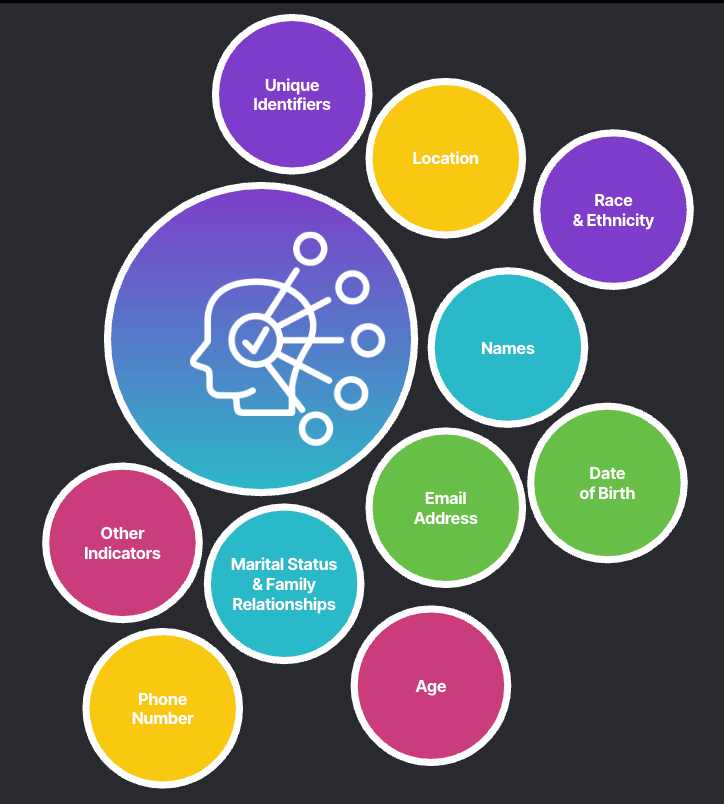
Many vendors run NLP on clinical notes before you ever receive them. That means someone else decides which fields you get and what goes into them, and you have no way to know what was left behind. HealthVerity Notes takes a different approach with a redaction model. PII is identified and removed or perturbed to meet HIPAA requirements, while the rest of the note stays intact. You get the full clinical context and can run your own NLP, use the notes as is or bring AI to them directly. Test scores and findings that never make it into a structured field live in these notes. Three sources already offer ambulatory notes for well over 100 million patients, with notes from Arcadia, Inovalon and Source 45 coming soon. |
What is de-identified in Notes?
PII categories and identifiers are obfuscated in the detect-replace model. |
Data spotlight: OneMedNet imaging
OneMedNet isn't new, but its breadth is often overlooked. It offers high-quality DICOM images and radiologist write-ups for more than 70 million patients, de-identified under HIPAA and recently licensed to a large U.S. AI company. Coverage spans autoimmune, cardiology, oncology and women's health, making it a strong complement to medical, pharmacy, lab and EMR data for disease progression studies and AI model building.
OneMedNet isn't new, but its breadth is often overlooked. It offers high-quality DICOM images and radiologist write-ups for more than 70 million patients, de-identified under HIPAA and recently licensed to a large U.S. AI company. Coverage spans autoimmune, cardiology, oncology and women's health, making it a strong complement to medical, pharmacy, lab and EMR data for disease progression studies and AI model building.
taXOnomy: comprehensive coverage, already packaged
For teams that want clean, ready-to-use data rather than raw sources, taXOnomy brings it together. taXOnomy X combines closed medical and pharmacy claims with the option to add EMR and lab, while taXOnomy XO also includes open data. Both offer 300+ million patients, patient journeys with 5+ years of enrollment, monthly refreshes and built-in deduplication.
The payoff shows up in the numbers. The industry benchmark for patient turnover is about 21%. When HealthVerity combined sources, it found higher retention and lower turnover than that benchmark suggests. Patients who appear to churn may simply have moved outside what a single source can capture.
HealthVerity eXOs: AI that questions your assumptions
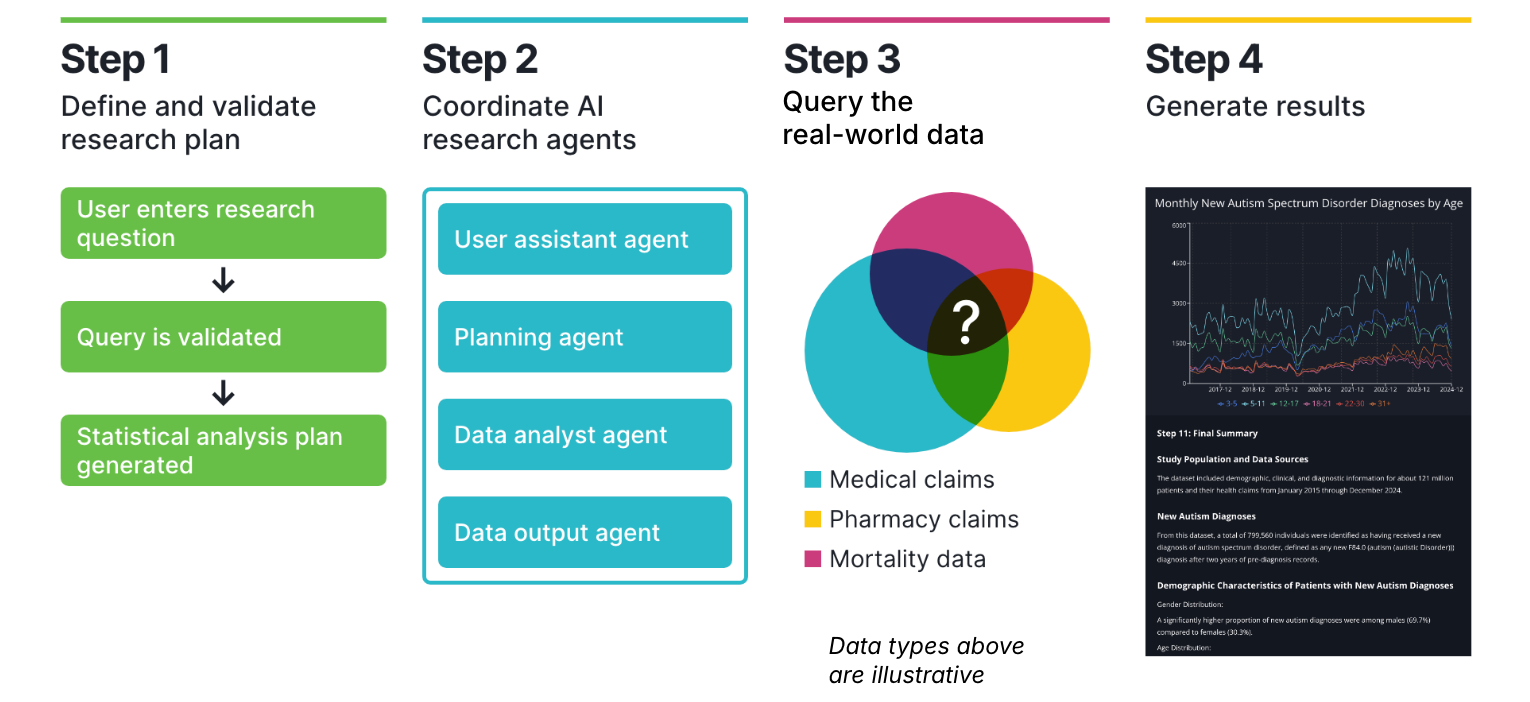
Every vendor has AI now. What makes HealthVerity eXOs different is that it's built to challenge you rather than hand you an answer from a black box.
Instead of an agent acting on its own, eXOs asks you qualifying questions: What does persistence mean for this study? Which time frame? Which market basket? It validates your assumptions, checks published research to see how others have approached the question, lets you choose the data underneath and returns the code and a full methodology write-up. You stay in control of the logic, and you can defend every result. And you get there in under 60 minutes instead of weeks.
Find the data that answers your question
Every source here carries the HealthVerity ID and is HIPAA compliant. When you add a new HealthVerity source, your existing HIPAA certification covers it. And HealthVerity remains the only provider that tells you exactly where each source comes from, with published data layouts and census-based epidemiology, so you understand the data before you license it.
What can't you see today? Tell us your therapeutic area and your question, and we'll show you which data makes the answer possible.